
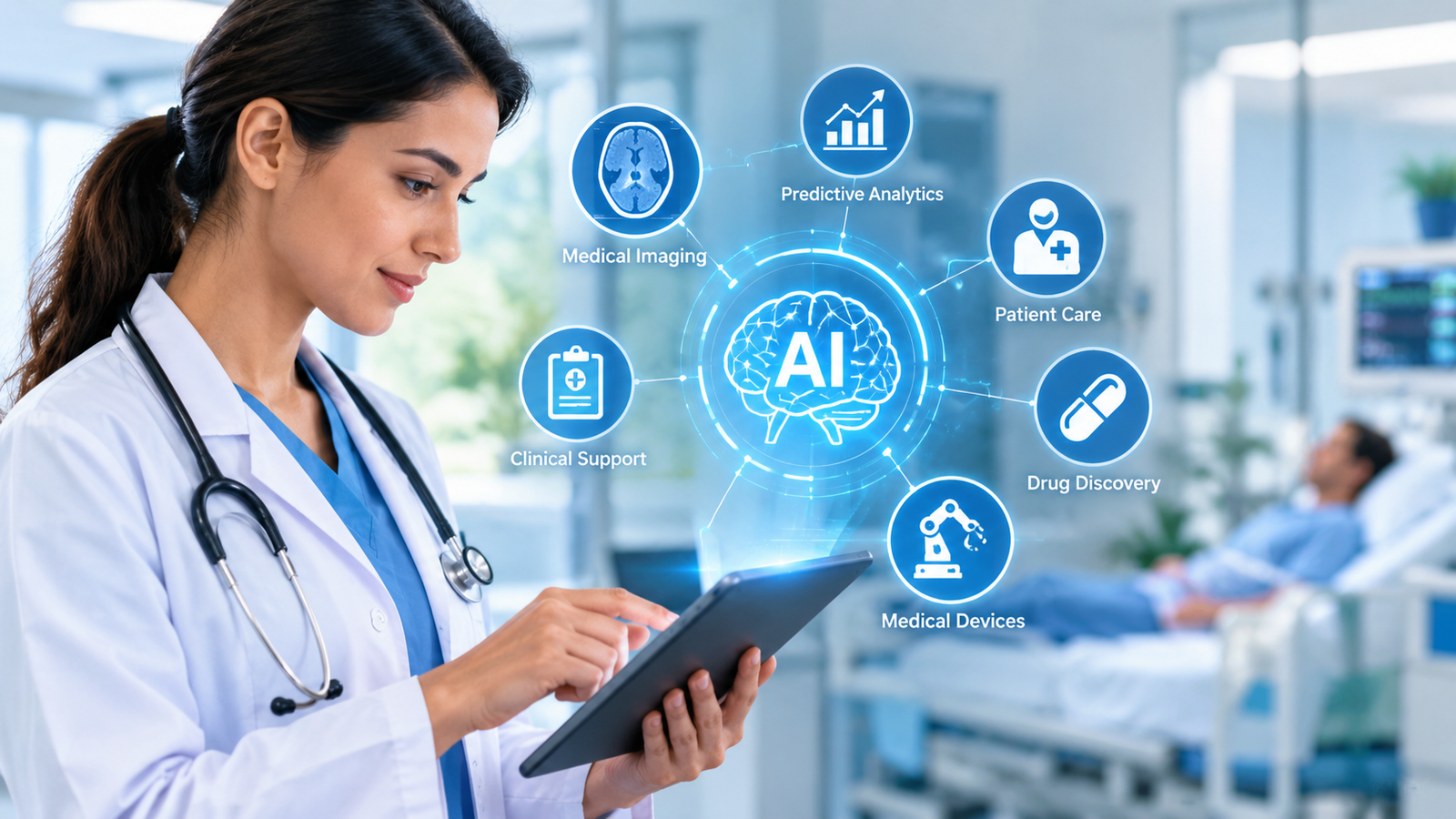

Artificial intelligence is becoming an important part of modern healthcare. Hospitals, researchers, medical technology companies and healthcare professionals are using AI to analyze information, identify patterns, support clinical decisions and develop new medical technologies.
The technology is no longer limited to futuristic concepts. AI is already being used in medical imaging, clinical decision support, health research and medical devices. The U.S. Food and Drug Administration says it had authorized more than 1,600 AI-enabled medical devices for marketing in the United States as of September 2026.
At the same time, the growth of this technology raises important questions about accuracy, privacy, bias, safety and human oversight. Understanding both the benefits and limitations is important as healthcare organizations continue adopting AI-based technologies.
Table of Contents
What Is AI in Healthcare?
AI in healthcare refers to computer systems that can analyze information, recognize patterns and perform specific tasks that traditionally require human intelligence. These systems can work with medical images, health records, laboratory information and other healthcare data.
AI does not necessarily mean that a computer is independently making medical decisions. In many applications, it works as a support tool that helps professionals review information or identify patterns more efficiently.
The capabilities of an AI system depend on how it was designed, trained, tested and approved for use. Some systems are developed for one specific medical task while others are designed to handle broader types of information.
How AI Is Used in Healthcare
Medical Imaging
Medical imaging is one of the major areas where AI is being used. AI systems can analyze X-rays, CT scans, MRI scans, retinal images and other medical images to identify patterns that may require further attention.
The FDA lists AI-enabled technologies that can provide diagnostic information from medical images, improve image quality and support the detection of conditions such as diabetic retinopathy. The agency also provides a searchable resource containing information about authorized AI-enabled medical devices.
These technologies can help professionals process large amounts of visual information more efficiently. However, an AI-generated result still needs to be interpreted within the appropriate clinical context.
Clinical Decision Support
AI can support clinical decision-making by analyzing available patient information and identifying patterns that may be relevant to healthcare professionals.
A clinical decision support system may help organize information, highlight potential concerns or provide analytical support. The purpose is generally to assist professionals rather than remove the need for clinical judgment.
Patient care involves many factors that may not be completely represented in a dataset. Medical history, physical examination, symptoms, preferences and other circumstances can all influence a healthcare decision.
Medical Research
Researchers are using AI to process large datasets and explore relationships that can be difficult to identify manually. This can support areas such as disease research, drug development, health data analysis and medical technology.
AI can make some data-heavy research tasks more efficient, but it does not remove the need for scientific validation. Researchers still need to determine whether an AI-generated result is accurate, meaningful and reproducible.
The World Health Organization’s 2026 report on AI-related health research examines ethics review and oversight and highlights issues such as fairness, privacy, human rights and accountability.
AI-Enabled Medical Devices
AI is increasingly being incorporated into medical devices used for diagnosis, monitoring and other healthcare applications.
According to the FDA, more than 1,600 AI-enabled medical devices had been authorized for marketing in the United States by September 2026. These devices cover a wide range of AI and machine learning technologies.
The growing number of authorized devices shows that AI has moved beyond experimental research and is becoming part of real-world healthcare technology.
Benefits of AI in Healthcare
Faster Data Analysis
One of the main advantages of AI is its ability to process large amounts of information quickly. Healthcare professionals may need to review extensive records, images or measurements, while an appropriately designed AI system can analyze large datasets efficiently.
This can be particularly useful in medical imaging and research where the amount of available information continues to grow.
Support for Healthcare Professionals
AI can provide analytical support that helps professionals review information more efficiently. When used appropriately, it can become another tool within an existing healthcare workflow.
The greatest value comes from combining technological analysis with professional judgment. AI can identify patterns, but healthcare professionals are still needed to understand the wider clinical context.
Potential for Earlier Detection
Some AI-enabled technologies are designed to identify patterns associated with certain diseases or health conditions. This may help healthcare professionals investigate a potential concern sooner.
However, the performance of each system depends on its intended purpose, testing and the population in which it is used. An AI system should not automatically be assumed to detect every health condition.
Support for Medical Research
AI can help researchers work with large datasets and explore complex relationships. This may contribute to research involving drug development, disease understanding and new healthcare technologies.
The technology can make some research processes more efficient, but scientific review remains necessary before conclusions are accepted.
AI and Nutrition
AI is also beginning to influence areas connected to nutrition and everyday wellness. Digital tools can organize food information, analyze nutritional data and help people explore meal ideas.
Understanding nutrient density is one useful part of learning about food quality. Nutravyntra’s guide to Most Nutrient Dense Foods explains the concept of nutrient density and discusses nutrient-rich food choices.
AI tools may also help organize meal ideas around available ingredients or personal preferences. However, general AI-generated nutrition information should not be treated as personalized medical advice.
People who want practical meal planning ideas can also explore Easy Meal Prep Ideas. Planning meals in advance can make everyday food preparation more organized and convenient.
AI and Mental Wellness
AI is also being discussed in relation to mental health and wellbeing. Digital technologies can help organize information, provide educational content and support certain healthcare workflows.
However, AI should not be treated as a replacement for qualified professional support when someone needs mental healthcare. Technology can provide general information but may not understand the full personal and clinical context of an individual.
For general wellbeing information, Nutravyntra’s article on Healthy Coping Strategies covers practical approaches for managing everyday stress and difficult emotions.
Risks and Limitations of AI in Healthcare
Accuracy
AI systems are not automatically accurate. Their performance depends on the quality of the data used to develop, train and evaluate them.
If the underlying data are incomplete or do not adequately represent the population where the system is used, performance can vary. This is particularly important in healthcare because incorrect information can affect important decisions.
Privacy
Healthcare information can contain sensitive personal data. AI systems that process medical records, images or other health information therefore require appropriate privacy and security protections.
Organizations need to consider how information is collected, stored, accessed and used. Responsible data governance is an important part of trustworthy healthcare technology.
Bias and Fairness
AI can reproduce or amplify problems that exist within the data used to develop it. If certain populations are poorly represented, an AI system may not perform equally well across different groups.
The WHO’s 2026 report highlights concerns involving fairness, inequity, privacy, accountability and other ethical challenges associated with AI-related health research.
Lack of Context
AI systems analyze the information available to them. They may not understand every aspect of a person’s situation.
Healthcare professionals can consider symptoms, medical history, examination findings and other circumstances together. This wider context is one reason human oversight remains important.
Overreliance on Technology
Another concern is excessive reliance on automated results. Even when an AI system performs well, its output needs to be considered within the purpose and limitations for which the system was designed.
Good healthcare requires technology to support appropriate decision-making rather than encourage people to accept computer-generated results without critical evaluation.
Human Oversight and Responsible AI
Human oversight is one of the most important principles in healthcare AI. Technology can support professionals but should not automatically replace professional responsibility.
The FDA continues to evaluate AI-enabled medical technologies through its medical device regulatory framework. Its work includes considering how these technologies should be assessed based on their intended use and potential risks.
The WHO’s September 2026 update on AI-related health research also calls for stronger ethics oversight and highlights concerns involving transparency, bias, fairness, accountability and privacy.
Responsible AI therefore involves more than creating an advanced system. It also requires appropriate testing, monitoring, governance and accountability.
Latest AI Healthcare Developments in 2026
AI healthcare regulation continued to develop during 2026.
In August 2026, the FDA published a discussion paper seeking public feedback on the regulatory approach for generative AI-enabled medical devices. The paper addresses topics including risk assessment, premarket evaluation and postmarket monitoring.
You can read the FDA’s discussion on generative AI-enabled medical devices for the agency’s current regulatory considerations.
This development is important because generative AI can behave differently from traditional software. Systems that generate or adapt information may require careful evaluation and ongoing monitoring.
The FDA’s public list of AI-enabled medical devices also shows how widely these technologies are being incorporated into medical products.
What Is the Future of AI in Healthcare?
The future will likely involve deeper integration between AI systems and existing healthcare infrastructure. Medical imaging, research, monitoring, clinical decision support and administrative processes are all areas where AI may continue to develop.
Generative AI may also influence how healthcare information is organized and communicated. However, healthcare applications require careful evaluation because errors can affect patient safety.
The WHO’s 2026 discussion on AI and evidence-informed health policy emphasizes that AI should augment human judgment rather than replace it.
Future progress will therefore depend not only on better algorithms but also on reliable data, stronger evaluation methods, appropriate regulation and human oversight.
The most useful systems may ultimately be those that work alongside healthcare professionals and make complex information easier to analyze without removing human responsibility.
Frequently Asked Questions
What is AI in healthcare?
AI in healthcare refers to the use of artificial intelligence technologies to analyze health information, identify patterns and support healthcare-related tasks.
How is AI used in hospitals?
AI can be used in areas such as medical imaging, clinical decision support, patient monitoring, medical research and AI-enabled medical devices.
Can AI replace doctors?
AI can support healthcare professionals but should not automatically be considered a replacement for professional medical judgment. Healthcare decisions often require context and expertise that an AI system may not have.
Is AI safe in healthcare?
The safety of an AI system depends on how it is designed, tested, regulated and used. Accuracy, privacy, bias, monitoring and human oversight are important considerations.
How does AI help medical research?
AI can analyze large datasets, identify patterns and support research activities such as data analysis, drug development and evaluation of new technologies.
Can AI help with nutrition?
AI can help organize nutrition information and generate general meal ideas. People with specific medical or dietary needs should rely on qualified healthcare professionals for personalized guidance.
What are the main risks of AI in healthcare?
Important risks include inaccurate results, privacy concerns, algorithmic bias, limited context and excessive reliance on automated outputs.
Why is AI becoming important in healthcare?
AI can process large amounts of information and support tasks that may otherwise require significant time and resources. Its growing use in medical devices and research is also contributing to its importance.
Conclusion
AI is becoming an increasingly important technology across modern healthcare. Its applications now include medical imaging, clinical decision support, medical research and AI-enabled medical devices.
The FDA reports that more than 1,600 AI-enabled medical devices had been authorized for marketing in the United States by September 2026. This demonstrates that AI is already being incorporated into real-world healthcare rather than remaining only a research concept.
At the same time, responsible use is essential. Accuracy, privacy, fairness, transparency and human oversight must remain important as healthcare organizations adopt new AI technologies.
The future of healthcare AI will not depend only on how advanced the technology becomes. It will also depend on how responsibly it is developed, evaluated and used. With appropriate safeguards and professional oversight, AI can become a valuable tool for supporting healthcare professionals, researchers and patients.


2 Comments