
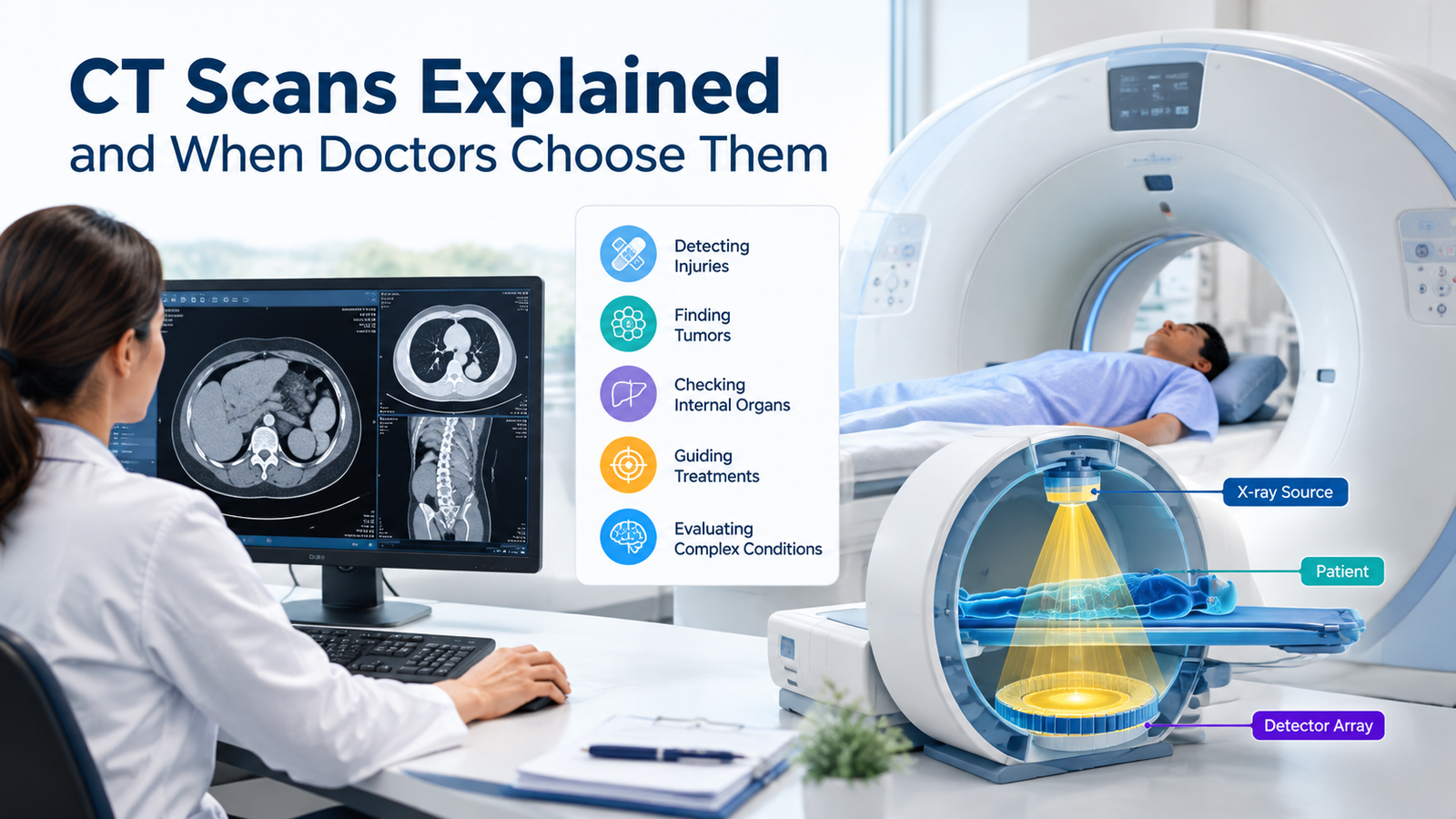

CT scans are one of the most useful imaging tests in modern medicine. They take detailed pictures inside the body in a few minutes and help doctors find injuries and infections and tumors and blood vessel problems. If your doctor has asked for one you may wonder how CT scans are used and what the test feels like.
This article answers the questions people ask most. It explains what CT stands for and what a scan can detect and how it compares with an MRI. It also covers how long it takes and what it costs and how to read your report. The information is educational and does not replace advice from a clinician who knows your health history.
Table of Contents
What Does CT Scan Stand For and What Is It
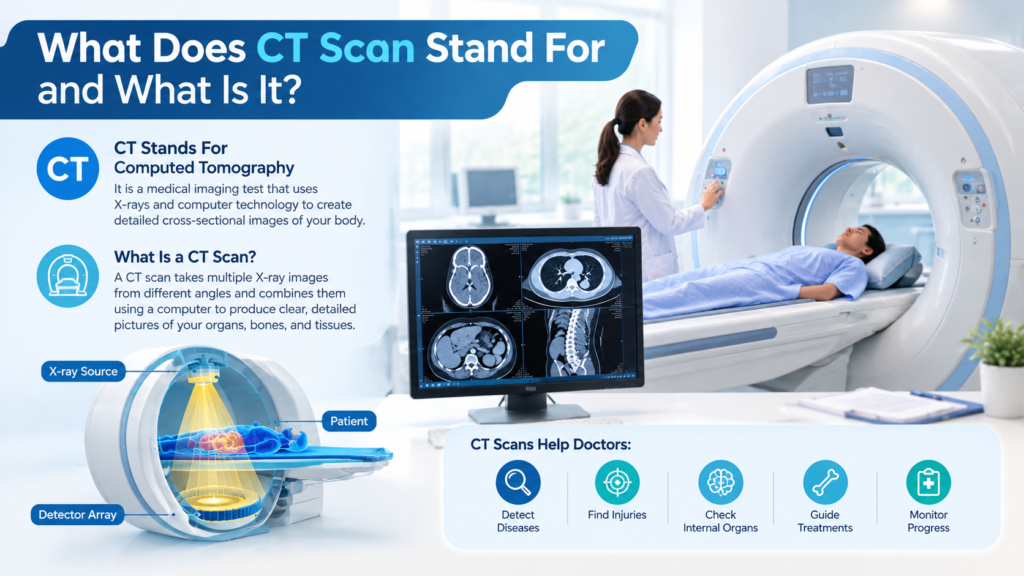
CT stands for computed tomography. The test is also called a CAT scan which comes from the older term computerized axial tomography. It uses X rays taken from many angles and a computer that combines them into detailed cross section pictures of the body.
A regular X ray gives a flat image where structures overlap. A CT scan works more like slicing a loaf of bread and looking at each slice. This lets doctors see organs and bones and blood vessels and soft tissue in much clearer detail.
How a CT Scanner Works
You lie on a table that slides through a large ring shaped machine. Inside the ring an X ray tube rotates around you and detectors measure how much radiation passes through the body. A computer turns those measurements into images that a radiologist can scroll through slice by slice.
The machine is open and quiet compared with an MRI. You may hear soft whirring or clicking sounds. A technologist watches from the next room and can speak with you through an intercom the whole time.
Contrast Dye Explained
Some scans use a contrast material that helps certain tissues and blood vessels show up more clearly. It may be given through a vein or taken as a drink or sometimes both. Many people feel a warm flush or a metallic taste for a short time after an injection.
Tell the staff about allergies and kidney disease and pregnancy and any diabetes medicines before the scan. Serious reactions are rare and the team is trained to manage them. Not every scan needs contrast and your doctor will decide based on the question being asked.
What Is the Most Common Reason for a CT Scan
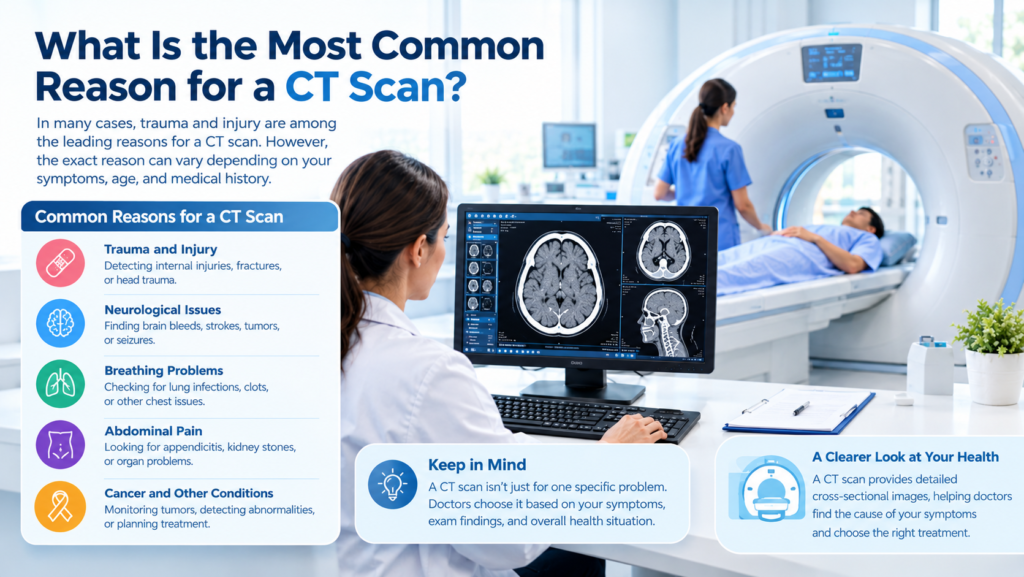
No single reason fits every country or hospital. In emergency care doctors often order CT scans after head injuries and accidents and for sudden severe abdominal pain. Outside the emergency room common reasons include checking cancer and following known tumors over time.
The table below shows typical situations where doctors choose a CT scan and why.
| Situation | Why CT is chosen |
|---|---|
| Head injury | Fast check for bleeding or skull fracture |
| Severe abdominal pain | Looks for appendicitis and kidney stones and blockages |
| Chest pain or shortness of breath | Checks the lungs and blood vessels for clots or other problems |
| Cancer diagnosis and follow up | Shows tumor size and spread |
| Major accident | Finds internal injuries quickly |
| Stroke symptoms | Rules out bleeding in the brain |
Emergency Room Uses
Speed is the main strength of CT in emergencies. A scan can be done in minutes and gives doctors a clear picture of bleeding and fractures and organ injury. This can guide urgent decisions about surgery and treatment.
Because the test is fast and widely available it is often the first advanced imaging test used when a person is seriously ill or injured.
Cancer Care and Screening
CT scans help doctors measure tumors and see whether cancer has spread. They are also used to check how well treatment is working. Low dose CT is used to screen certain older adults with a heavy smoking history for lung cancer.
Screening is not right for everyone. Doctors weigh benefits and risks and follow national guidelines when deciding who should be offered it.
What Can CT Scans Detect
CT scans can detect a wide range of problems. They are especially good at showing bones and lungs and bleeding and many types of tumors. They can also show infections and blockages and changes in blood vessels.
The table below gives examples by body area. A scan does not find every condition and doctors combine results with symptoms and other tests.
| Body area | Examples of what CT can help find |
|---|---|
| Head and neck | Bleeding and fractures and sinus disease and some tumors |
| Chest | Lung nodules and pneumonia and blood clots and aortic problems |
| Abdomen and pelvis | Appendicitis and kidney stones and tumors and abscesses |
| Bones and spine | Fractures and joint problems and spinal changes |
| Blood vessels | Aneurysms and narrowing and clots |
Head and Neck
A head CT is often used after an injury or when someone has sudden severe headache or stroke symptoms. It can show bleeding and swelling and fractures within minutes. It can also help evaluate sinus problems and some neck conditions.
For detailed views of brain tissue an MRI may be better. Doctors choose the test that answers the question most safely and quickly.
Chest and Heart
Chest CT is useful for lung disease and for finding blood clots in the lungs. It can show tiny nodules that a standard chest X ray may miss. A heart CT can measure calcium in the coronary arteries which helps assess heart disease risk.
CT angiography uses contrast to show the blood vessels in detail. It helps find aneurysms and blockages without surgery.
Abdomen and Pelvis
Abdominal CT is a go to test for unexplained pain. It can show appendicitis and kidney stones and inflammation and abscesses and many tumors. It also helps doctors plan surgery and monitor chronic conditions.
Preparation may include fasting for a few hours and drinking oral contrast before the scan. Follow the instructions from your imaging center closely.
Bones and Blood Vessels
CT shows bone detail very well. It is used for complex fractures and joint problems and some spine conditions. It can also guide procedures such as biopsies.
For blood vessels CT angiography gives a quick map of arteries and veins. This helps diagnose clots and bleeding and vessel damage.
CT Scan Versus MRI Scan
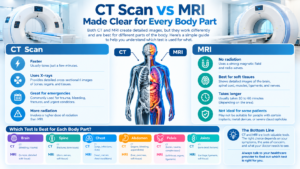
CT and MRI are both imaging tests but they work in different ways. CT uses X rays while MRI uses strong magnets and radio waves. Neither is always better. The right choice depends on the body part and the question and how urgent the situation is.
| Feature | CT scan | MRI scan |
|---|---|---|
| How it works | X rays and computer processing | Magnets and radio waves |
| Typical scan time | A few minutes | About 30 to 60 minutes |
| Best for | Bones and lungs and bleeding and emergencies | Brain and spinal cord and ligaments and soft tissue |
| Radiation | Yes in small amounts | No |
| Noise | Quiet | Loud knocking sounds |
| Metal implants | Usually acceptable | Some implants are unsafe |
| Cost | Often lower | Often higher |
When CT Is Better
CT is often better when speed matters. It is the usual choice for trauma and suspected bleeding and many chest and abdominal problems. It also works well for people who cannot stay still for a long time or who have certain implants.
When MRI Is Better
MRI gives superior detail of soft tissue. Doctors often choose it for the brain and spinal cord and joints and ligaments and some pelvic organs. It avoids ionizing radiation which can matter for children and for people who need repeated scans.
MRI takes longer and the machine is narrower and louder. People with some pacemakers or metal fragments may not be able to have one.
How Long Does a CT Scan Take
The scan itself is usually fast. Most CT scans take about 5 to 10 minutes on the table and the actual imaging is often only a few seconds to a minute. The whole visit takes longer because of paperwork and preparation.
| Step | Typical time |
|---|---|
| Check in and forms | 10 to 20 minutes |
| Changing and preparation | 5 to 15 minutes |
| Placing an IV if contrast is used | 5 to 10 minutes |
| Scanning | 5 to 10 minutes |
| Short observation after contrast | Up to 30 minutes |
Before the Scan
You may be asked to avoid food for a few hours and to drink water or oral contrast. Remove jewelry and metal items and wear comfortable clothing. Tell the staff about allergies and medicines and kidney problems.
Arrive a little early. Drinking oral contrast can take an hour or more and this adds to the total visit time.
During the Scan
You lie still on the table while it moves through the ring. You may be asked to hold your breath for a few seconds. If contrast is injected you may feel warmth and a metallic taste that passes quickly.
The technologist can see and hear you throughout. If you feel uncomfortable say so right away.
After the Scan
Most people go back to normal activities right away. If you had contrast drinking extra water helps flush it out. Report any rash or swelling or trouble breathing to the staff or a doctor immediately.
Results are usually sent to your doctor within a day. In urgent cases a radiologist reports within minutes.
CT Scan Price and What Affects It
CT scan prices vary widely. In the United States costs can range from a few hundred dollars at a standalone imaging center to several thousand dollars at a hospital. Prices in other countries depend on the city and the facility and the type of scan.
Published price lists online are often outdated or unreliable. Ask the imaging center for a written estimate before the scan and ask what is included.
| Factor | How it affects the price |
|---|---|
| Body area | Larger or more complex scans cost more |
| Contrast | Adds the cost of the material and staff time |
| Facility type | Hospitals often charge more than imaging centers |
| Location | Big cities and some regions cost more |
| Urgency | Emergency scans can cost more |
| Insurance | Coverage and network status change what you pay |
Insurance and Payment
Insurance often covers medically necessary CT scans but you may still pay a deductible or a share of the cost. Check whether the imaging center is in your network and whether your plan needs prior approval.
If you pay out of pocket ask about cash prices and payment plans. Many centers offer lower self pay rates.
Ways to Lower Cost Safely
Compare a few facilities and ask your doctor whether an imaging center is suitable. Do not skip or delay a scan only because of cost when your doctor says it is needed. Talk openly with your care team about budget concerns.
Avoid unnecessary repeat scans by bringing earlier images and reports to new appointments.
How to Read a CT Scan Report
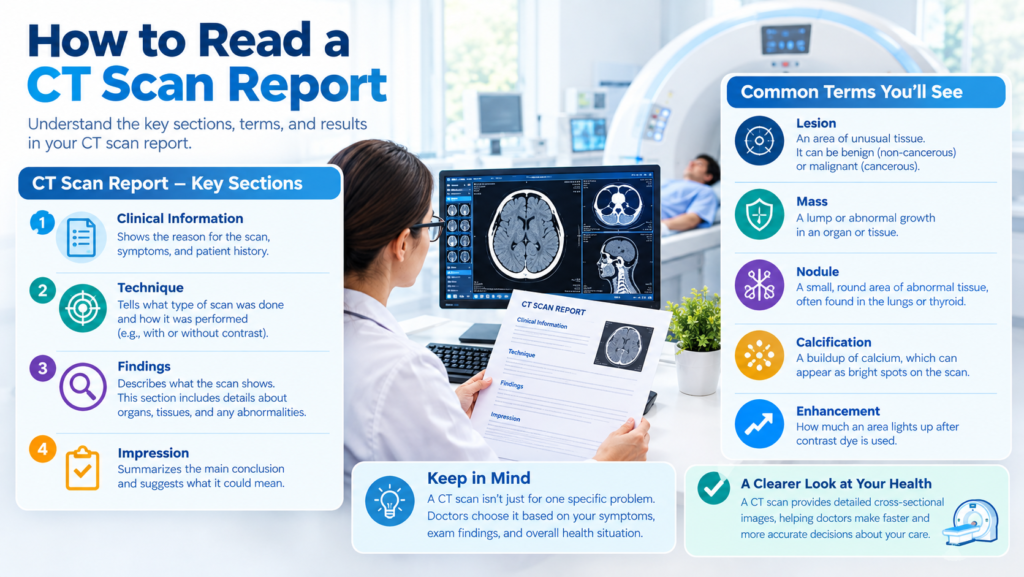
A radiologist reviews the images and writes a report for your doctor. It usually includes the reason for the scan and the technique and comparison with earlier images and the findings and an impression. The impression is a short summary and is the part most doctors read first.
Reports use technical language. A phrase that sounds worrying may be harmless and a normal sounding phrase may still need follow up. Your doctor connects the report with your symptoms.
| Term | What it usually means |
|---|---|
| Unremarkable | Nothing abnormal was seen |
| Stable | No change compared with earlier scans |
| Incidental finding | Something unrelated to the reason for the scan |
| Nodule | A small spot that may need follow up |
| Lesion | An area that looks different from normal tissue |
| Recommend correlation | The doctor should compare with symptoms or other tests |
Common Terms Explained
Many reports mention words like nodule and cyst and lesion. These describe appearance and not a diagnosis. Most small cysts and nodules are harmless but some need follow up scans.
Trusted health sources such as MedlinePlus explain medical imaging tests in plain language and can help you understand the terms in your report.
What to Do With Your Report
Do not rely on search results to interpret your scan. Book a visit with your doctor to go through the findings. Write down questions about next steps and ask for a copy of the report and images.
If you are unsure whom to see first ask your primary care clinician who can guide you to the right specialist.
Are CT Scans Safe
CT scans are generally safe and the benefits usually outweigh the risks when a scan is medically needed. The main concerns are radiation exposure and reactions to contrast material. Doctors try to use the lowest dose that gives a clear answer.
The National Cancer Institute explains radiation and CT in its CT scans fact sheet which is a good place to learn more about risks and benefits.
Radiation Dose
A CT scan uses more radiation than a standard X ray. Depending on the scan the dose can be equal to a few months or a few years of natural background radiation. The added risk of cancer from one scan is small but it adds up with many scans.
Tell your doctor about earlier scans. Children and pregnant women need special care and doctors often choose other tests when they can.
Contrast Dye and Kidney Health
Contrast material is usually well tolerated. People with kidney disease or severe allergies need extra planning. The team may check kidney function with a blood test and adjust the plan.
Tell the staff about all medicines and conditions. Drinking water after the scan helps most people clear the contrast.
Latest Update on CT Scans This Year
CT technology keeps improving. Research reported in July 2026 described a drop in typical CT radiation dose compared with a similar study from 2014 based on millions of exams. Photon counting CT is also drawing attention because studies report it can lower dose in some chest scans while keeping image quality high.
Artificial intelligence is another trend. Regulators have cleared software that supports lung cancer screening and heart risk assessment on CT images. These tools help radiologists and do not replace them.
When to Talk With a Doctor About a CT Scan
Ask your doctor why a scan is needed and what the result will change. Good questions include whether another test could answer the same question and whether contrast is needed and how you will get results.
Seek urgent care for sudden severe pain or head injury or stroke symptoms or trouble breathing and do not wait for a scan appointment. Bring earlier scans and reports so your doctor can compare them.
Frequently Asked Questions
What does CT scan stand for?
CT stands for computed tomography. It is also called a CAT scan.
What is the most common reason for a CT scan?
There is no single answer. Common reasons include head injuries and abdominal pain and chest problems and cancer follow up.
How long does a CT scan take?
The scan itself usually takes about 5 to 10 minutes. The full visit often lasts 30 to 60 minutes or more.
What can CT scans detect?
They can detect bleeding and fractures and infections and tumors and blood clots and many organ problems.
Is a CT scan better than an MRI?
Neither is always better. CT is faster and good for bones and emergencies while MRI shows soft tissue in more detail.
How much does a CT scan cost?
Cost varies by country and facility and scan type. Ask for a written estimate before the test.
Is a CT scan painful?
The scan is painless. You may feel a small pinch if an IV is placed and a warm feeling with contrast.
How soon do I get CT scan results?
Results often reach your doctor within a day. Urgent scans are read much faster.
Final Thoughts
CT scans give doctors a fast and detailed look inside the body and help them make safe decisions. Knowing what the test shows and how it compares with an MRI makes the process less stressful.
Ask questions and follow preparation steps and review your report with a doctor. When a scan is needed its benefits usually far outweigh the small risks and good communication with your care team makes the experience smoother.



One Comment