
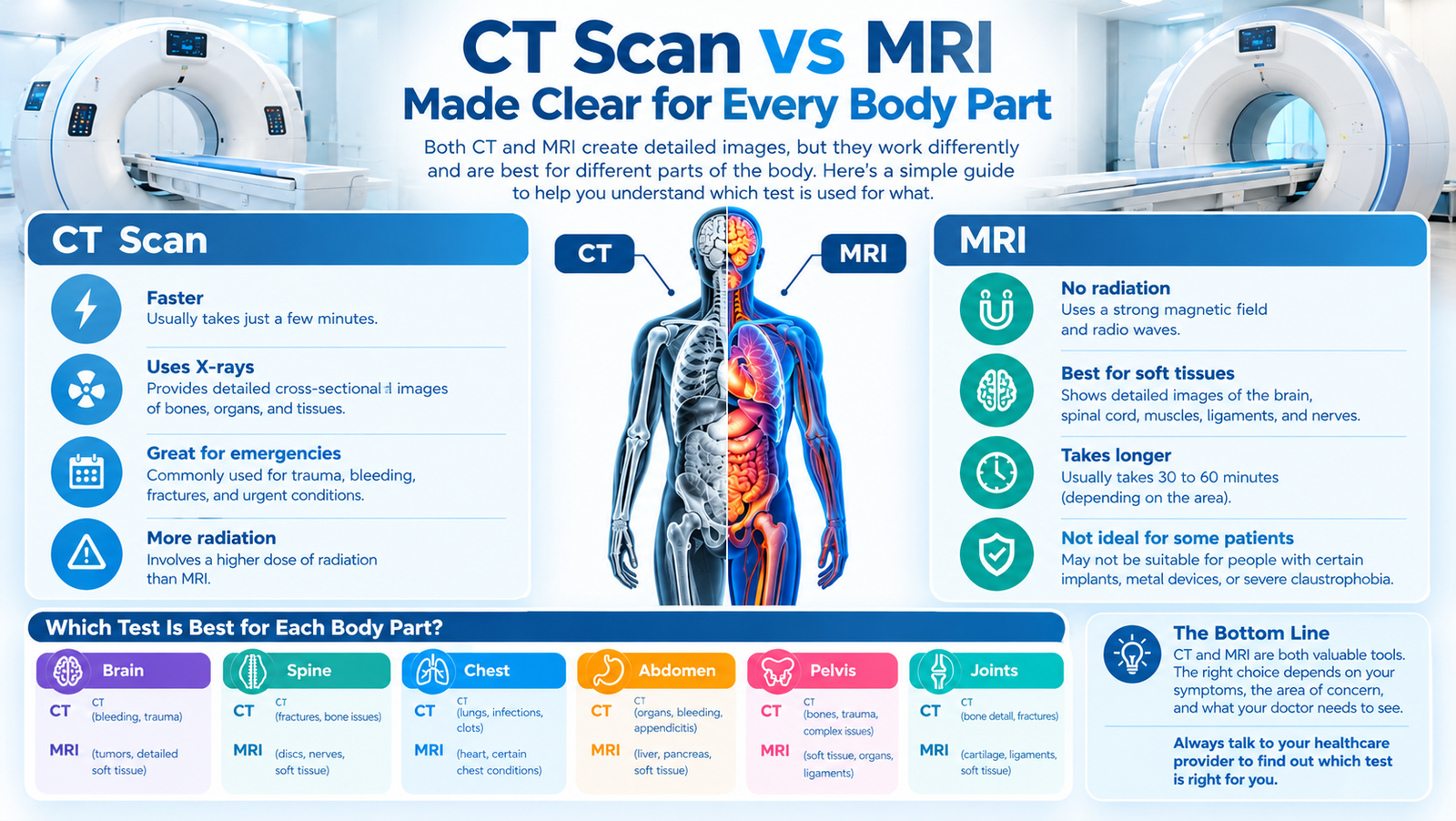

The choice between a CT scan vs MRI confuses many patients. Both tests show the inside of the body in detail but they use different technology and suit different problems. One is fast and strong for bones and emergencies. The other takes longer and shows soft tissue with remarkable clarity.
This article compares the two in plain language. It covers kidney and spine imaging and safety and cost and claustrophobia. It also explains how CAT scans and ultrasound and PET scans fit in. The information is educational and does not replace advice from a clinician who knows your health history.
Table of Contents
CT Scan vs MRI at a Glance
A CT scan uses X rays and a computer to build cross section pictures. An MRI uses a strong magnet and radio waves to do the same without ionizing radiation. Both give detailed images but they do not see tissue in the same way.
The table below gives a quick side by side view before the sections that follow.
| Feature | CT scan | MRI scan |
|---|---|---|
| Technology | X rays and computer processing | Magnet and radio waves |
| Typical scan time | A few minutes | About 30 to 60 minutes |
| Strongest at | Bones and lungs and bleeding and emergencies | Brain and spinal cord and joints and soft tissue |
| Radiation | Yes in small amounts | No |
| Noise level | Quiet | Loud knocking sounds |
| Metal implants | Usually acceptable | Some are unsafe |
| Cost | Often lower | Often higher |
What Is a CT Scan
CT stands for computed tomography. A rotating X ray tube takes many images from different angles and a computer turns them into slices of the body. The test is quick and widely available which makes it a first choice in emergencies.
CT shows bone and lung detail very well and finds bleeding and kidney stones and many tumors. It uses a small dose of radiation and sometimes needs contrast dye for clearer pictures.
What Is an MRI Scan
MRI stands for magnetic resonance imaging. The magnet lines up tiny particles in the body and radio waves create signals that a computer converts into images. There is no ionizing radiation involved.
MRI shows soft tissue such as the brain and spinal cord and ligaments and muscles with superb contrast. The price of that detail is a longer scan and a narrow loud machine.
CT Scan vs CAT Scan Is There a Difference
There is no difference. CAT stands for computerized axial tomography which is the older name for CT. Many people and some imaging centers still use both terms for the same test.
If a doctor says CAT scan or CT scan they mean the same X ray based scan. The confusion often comes from people mixing it up with MRI or PET which are different technologies.
Which Is Better MRI or CT Scan for Kidney
The answer depends on the question being asked. For kidney stones a CT scan without contrast is usually the most accurate test and takes only minutes. For blood in the urine or a suspected mass either test may be used and the doctor picks based on the situation.
Ultrasound is often the first step because it is safe and easy and shows blockage and swelling. CT and MRI come next when more detail is needed.
| Kidney question | Often preferred test | Why |
|---|---|---|
| Suspected kidney stones | CT scan | Finds small stones quickly |
| First look at pain or swelling | Ultrasound | No radiation and easy to do |
| Kidney mass needing detail | CT or MRI | Both show size and features |
| Repeat scans without radiation | MRI | Avoids X ray exposure |
| Pregnancy | Ultrasound then MRI if needed | Avoids radiation |
When CT Is Preferred for Kidneys
CT is the standard for stones and for urgent problems such as injury or severe infection. It is fast and shows the whole urinary tract in detail. Contrast helps show blood flow and masses but needs a kidney function check first.
When MRI Is Preferred for Kidneys
MRI is useful when radiation should be avoided or when CT contrast is not suitable. It can show the nature of a kidney mass in great detail without X rays. Contrast for MRI also needs planning for people with severe kidney disease so tell the team about your kidney health.
CT Scan vs MRI for the Spine
MRI is usually the best test for spine problems that involve soft tissue. It shows discs and nerves and the spinal cord clearly and helps find slipped discs and nerve pressure and tumors. This is why it is the common choice for back pain with leg weakness or numbness.
CT is better for bone detail. It shows fractures and bony changes and is often used after injury. It also helps when a person cannot have an MRI because of an implant.
Bone and Fracture Detail
After an accident doctors often start with a CT scan because it shows fractures fast. It gives sharp images of vertebrae and can guide surgery planning. For bone questions CT often wins on speed and clarity.
Discs and Nerves
For pain that spreads down the arm or leg MRI is usually the stronger test. It shows how a disc presses on a nerve and whether the spinal cord is affected. Doctors may order both tests when they need bone and soft tissue detail together.
CT Scan vs MRI Which Is Safer
Both tests are considered safe when used properly. The main difference is radiation. CT uses ionizing radiation while MRI does not. For most adults one CT scan carries a small risk and doctors use the lowest dose that gives a clear answer.
MRI has its own safety rules because of the strong magnet. Some metal implants and devices are not safe in the scanner so screening forms matter.
| Safety point | CT scan | MRI scan |
|---|---|---|
| Radiation | Yes in small amounts | None |
| Contrast material | Iodine based | Gadolinium based |
| Metal implants | Usually fine | Some are unsafe |
| Pregnancy | Avoided unless needed | Used when needed with care |
| Kidney disease | Contrast needs planning | Contrast needs planning |
| Children | Dose kept as low as possible | Often preferred when possible |
Radiation and Contrast
A CT scan dose can equal a few months to a few years of natural background radiation depending on the body area. Repeated scans add up so tell your doctor about earlier imaging. Contrast reactions are uncommon and staff are trained to manage them.
Implants and Pregnancy
Always tell the team about pacemakers and clips and joint replacements and any metal in the body before an MRI. Tell them if you might be pregnant before any scan. Ultrasound or MRI is often chosen during pregnancy to avoid radiation.
CT Scan vs MRI Cost
MRI usually costs more than CT. The machine is more expensive and the scan takes longer. Ultrasound is typically the least costly and PET scans are often the most expensive.
Exact prices vary by country and city and facility. Ask for a written estimate and confirm what is included such as the radiologist fee and contrast.
| Factor | Effect on price |
|---|---|
| Type of scan | MRI is often higher than CT |
| Body area | Larger or complex areas cost more |
| Contrast | Adds material and staff cost |
| Facility | Hospitals often charge more than imaging centers |
| Insurance | Coverage and network status change what you pay |
| Urgency | Emergency scans may cost more |
Why MRI Costs More
MRI machines need strong magnets and special rooms and the scan occupies the machine for longer. That means fewer patients per day and higher cost per scan. These factors explain most of the gap with CT.
Ways to Manage Cost
Compare a few accredited centers and bring earlier scans so repeats are avoided. Ask your doctor whether a cheaper test can answer the same question. Never delay a needed scan only because of price without talking to your care team.
CT Scan vs MRI Claustrophobia
Claustrophobia is a common reason people worry about scans. CT is usually easier because the ring is short and open and the scan lasts only minutes. Many people with mild anxiety manage a CT scan comfortably.
MRI is harder for some people. You lie inside a long tube for 30 to 60 minutes and the machine is loud. This does not mean MRI is impossible. Several options can help.
Making an MRI Easier
Tell the staff about your fear in advance. Ask about wide bore or open MRI machines and about music or headphones and an eye mask. A relative can often stay in the room. Some people practice slow breathing and ask for short breaks between scans.
When Sedation Is Considered
For severe anxiety a doctor may prescribe a mild sedative before the scan. Never take medicine on your own for this purpose. Arrange a ride home since drowsiness can last for hours. If MRI is not possible a CT scan may answer the question instead.
CT Scan vs MRI vs Ultrasound
Ultrasound uses sound waves and not radiation. It is fast and portable and shows blood flow in real time. It works very well for the gallbladder and kidneys and thyroid and pregnancy. Gas and bone can block the sound so it cannot see everything.
| Feature | CT scan | MRI scan | Ultrasound |
|---|---|---|---|
| Technology | X rays | Magnet and radio waves | Sound waves |
| Radiation | Yes | No | No |
| Scan time | A few minutes | 30 to 60 minutes | 15 to 45 minutes |
| Best for | Emergencies and bones and chest | Brain and spine and soft tissue | Pregnancy and kidneys and gallbladder |
| Cost | Moderate | Higher | Lower |
When Ultrasound Comes First
Doctors often start with ultrasound for abdominal pain and pregnancy and thyroid lumps. It is safe and inexpensive and can guide the next step. If the answer is unclear a CT scan or MRI follows.
CT Scan vs MRI vs PET Scan
A PET scan works very differently. It uses a small amount of radioactive tracer that shows how active tissues are. Cancer cells often use more energy than normal cells so they light up on the scan. PET shows function while CT and MRI show structure.
| Feature | CT scan | MRI scan | PET scan |
|---|---|---|---|
| What it shows | Structure | Structure and soft tissue detail | Activity of cells |
| Technology | X rays | Magnet and radio waves | Radioactive tracer |
| Typical use | Injury and screening | Brain and joints and spine | Cancer staging and some brain and heart conditions |
| Typical visit time | Under an hour | About an hour | Often about two hours |
| Cost | Moderate | Higher | Often highest |
PET CT and PET MRI
PET is often combined with CT or MRI in one machine. The CT or MRI part shows exactly where the active spot sits. This helps doctors stage cancer and plan treatment and check response. PET MRI avoids the extra CT radiation but is less widely available.
How Doctors Choose the Right Scan
Doctors weigh the body area and the suspected problem and urgency and safety. They also consider age and pregnancy and kidney function and implants and cost. The best test is the one that answers the question with the least risk.
A good approach is to ask three questions. What are you looking for and why this test and is there a safer or simpler option. Clear answers help you feel confident about the plan.
Latest Update on CT and MRI
Imaging keeps improving. Research reported in July 2026 described a decline in typical CT radiation dose compared with a similar study from 2014 based on millions of exams. Photon counting CT is also drawing attention because studies report lower dose in some chest scans.
Artificial intelligence is helping both tests. Many centers use it to improve image quality and shorten MRI scan times. Regulators have also cleared AI tools that assist with lung cancer screening on CT. These tools support radiologists and do not replace them.
When to Talk With a Doctor About Your Scan
Ask why a test is needed and what the result will change. Share your history of allergies and kidney disease and implants and pregnancy. Bring earlier scans and reports so your doctor can compare them.
Seek urgent care for sudden severe pain or head injury or stroke symptoms or trouble breathing and do not wait for a scan appointment.
Frequently Asked Questions
Which is better CT scan or MRI?
Neither is always better. CT is faster and best for bones and emergencies while MRI shows soft tissue in more detail.
Which is better MRI or CT scan for kidney problems?
CT is usually best for kidney stones and urgent problems. MRI is useful when radiation should be avoided or more detail on a mass is needed.
Which is safer CT scan or MRI?
MRI uses no radiation. CT uses a small dose that is considered safe when the scan is needed.
Is a CAT scan the same as a CT scan?
Yes. CAT is the older name for CT.
Is CT or MRI better for the spine?
MRI is better for discs and nerves and the spinal cord. CT is better for bone detail and fractures.
Is a CT scan easier than an MRI for claustrophobia?
Usually yes. The CT ring is short and the scan lasts only minutes while MRI takes longer inside a tube.
Which costs more CT scan or MRI?
MRI usually costs more. Prices vary by country and facility so ask for an estimate.
What is the difference between a PET scan and a CT scan?
PET shows how active tissues are using a tracer while CT shows structure using X rays. They are often combined.
Final Thoughts
The right choice in the CT scan vs MRI debate depends on the problem and not on which test sounds more advanced. CT is quick and excellent for bones and emergencies. MRI gives superb soft tissue detail without radiation. Ultrasound and PET fill other roles.
Ask questions and share your full history and trust your care team to match the test to your situation. Understanding the differences makes you a more confident partner in your own care.



One Comment