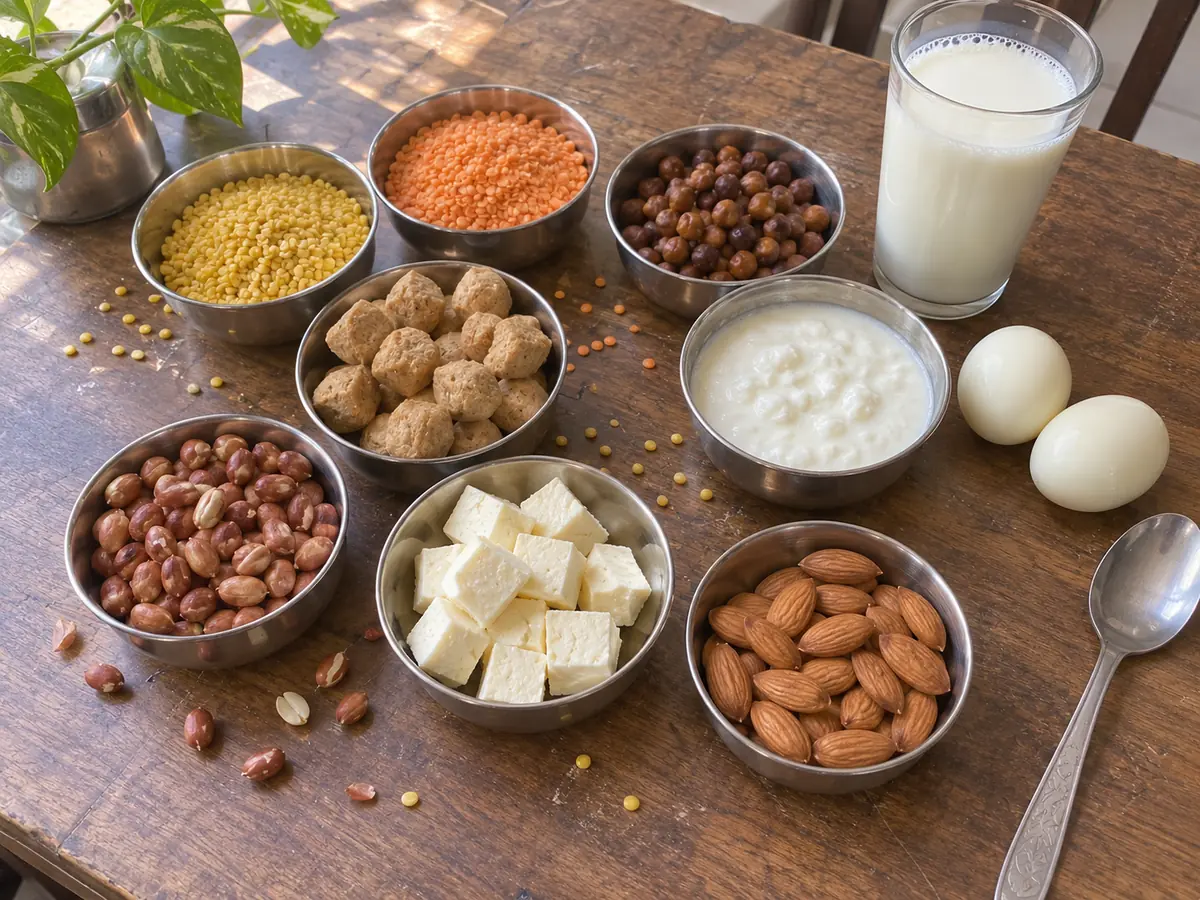

Quick answer: The protein meaning in Hindi is प्रोटीन, a पोषक तत्व (nutrient) that builds and repairs the body. It is made of small units called amino acids (अमीनो एसिड) and is found in foods like dal, chana, paneer, milk, eggs, soya and chicken.
Protein is one of the most talked about words in food and fitness. You see it on milk packets, gym posters and protein powder boxes. But what does protein actually mean, what does it do in the body, and how much do you really need?
In this article we explain the protein meaning in Hindi in simple words, its main functions, protein-rich desi foods with grams per 100 g and per serving, how much protein you need per day according to ICMR, signs of too little protein, diseases caused by protein deficiency, and quick facts often asked in exams.
Table of Contents
Protein Meaning in Hindi (and Urdu)
| English | Hindi | Urdu |
|---|---|---|
| Protein | प्रोटीन | پروٹین (لحمیات) |
| Nutrient | पोषक तत्व | غذائی جزو |
| Amino acids | अमीनो एसिड | امینو ایسڈ |
| Protein-rich food | प्रोटीन से भरपूर भोजन | پروٹین والی غذا |
| Protein deficiency | प्रोटीन की कमी | پروٹین کی کمی |
In everyday Hindi, people simply say प्रोटीन, and in Urdu it is written پروٹین. It is one of the three main nutrients that give the body energy, along with carbohydrates (कार्बोहाइड्रेट) and fat (वसा).
प्रोटीन क्या है? (What Is Protein in Hindi)
प्रोटीन एक ज़रूरी पोषक तत्व है जो शरीर की मांसपेशियों, हड्डियों, त्वचा, बालों और खून को बनाने और उनकी मरम्मत करने में मदद करता है। प्रोटीन छोटे-छोटे हिस्सों से बना होता है जिन्हें अमीनो एसिड कहते हैं। शरीर को कुल 20 अमीनो एसिड चाहिए, जिनमें से 9 को “ज़रूरी अमीनो एसिड” कहा जाता है, क्योंकि शरीर इन्हें खुद नहीं बना सकता और ये हमें खाने से मिलते हैं।
Protein Definition in Simple Words
Protein is a nutrient made of chains of amino acids. Your body breaks the protein in food into amino acids and then uses them to build and repair muscles, skin, hair, blood, hormones and enzymes. There are 20 amino acids, and 9 of them are called essential amino acids because the body cannot make them; they must come from food.
Quick Facts About Protein (प्रोटीन से जुड़े तथ्य)
| Question | Answer |
|---|---|
| Protein is made of (प्रोटीन किससे बनता है) | Amino acids (अमीनो एसिड) |
| Elements in protein (प्रोटीन में कौन से तत्व होते हैं) | Carbon, hydrogen, oxygen and nitrogen, often with sulphur (कार्बन, हाइड्रोजन, ऑक्सीजन, नाइट्रोजन और अक्सर सल्फर) |
| Total amino acids used by the body | 20, of which 9 are essential (ज़रूरी) |
| Energy from protein | About 4 calories per gram |
| Who named protein (प्रोटीन नाम किसने दिया) | The word was suggested by Swedish chemist Jöns Jacob Berzelius in 1838, and first used by Dutch chemist Gerardus Johannes Mulder, who is often given credit for its discovery in Indian exam books |
| Meaning of the word | From the Greek word “proteios”, meaning “of first importance” (सबसे ज़रूरी) |
| Richest common vegetarian source | Soybean and soya chunks (सोयाबीन) |
Functions of Protein (प्रोटीन के काम)
- Builds and repairs muscles (मांसपेशियों का निर्माण और मरम्मत).
- Helps growth in children, teenagers and during pregnancy (बच्चों और गर्भावस्था में विकास).
- Makes enzymes and hormones that control digestion, energy and many body processes (एंजाइम और हार्मोन बनाना).
- Supports immunity: antibodies that fight infection are proteins (रोग प्रतिरोधक क्षमता).
- Keeps hair, skin and nails healthy (बाल, त्वचा और नाखून).
- Keeps you full for longer, which can help with weight control (पेट भरा रखना).
- Gives energy: 1 g of protein gives about 4 calories.
Types of Protein: Complete and Incomplete
- Complete protein (पूर्ण प्रोटीन): has all 9 essential amino acids. Examples: eggs, milk, curd, paneer, chicken, fish and soya.
- Incomplete protein (अपूर्ण प्रोटीन): low in one or more essential amino acids. Most dals, chana, beans, nuts and grains are in this group.
- Easy fix for vegetarians: eat dal or chana with roti or rice. Together they give all the essential amino acids, which is why dal-chawal and chole-roti work so well.
Protein-Rich Foods in Hindi (प्रोटीन वाले फूड)
Values are approximate per 100 g, from USDA FoodData Central and brand labels.
| Food (Hindi) | Protein per 100 g |
|---|---|
| Soya chunks, dry (सोया चंक्स) | About 52 g |
| Chicken breast, cooked (चिकन) | About 29 g |
| Peanuts (मूंगफली) | About 26 g |
| Moong dal, dry (मूंग दाल) | About 24 g |
| Masoor dal, dry (मसूर दाल) | About 24 to 25 g |
| Almonds (बादाम) | About 21 g |
| Chana, dry (चना) | About 20.5 g |
| Paneer (पनीर) | About 20 g |
| Eggs (अंडा), about 2 eggs | About 12.5 g |
| Curd (दही) | About 3.5 g |
| Milk (दूध) | About 3.2 g |
Dry dals and chana have less protein per 100 g once cooked, because they absorb water. For details, see our guides to soya chunks protein per 100g, paneer protein per 100g, chana protein per 100g and boiled chicken breast calories.
Protein in Common Servings
| Serving | Protein (about) |
|---|---|
| 1 large egg (अंडा) | 6 g |
| 1 glass milk, 250 ml (दूध) | 8 g |
| 1 cup curd, about 245 g (दही) | 8.5 g |
| 100 g paneer (पनीर) | 18 to 20 g |
| 1 katori cooked dal, about 150 g (दाल) | 7 to 12 g, depending on the dal and how thick it is |
| 1 cup boiled chana, 164 g (चना) | 14.5 g |
| 30 g peanuts, a small handful (मूंगफली) | 8 g |
| 30 g dry soya chunks (सोया चंक्स) | 16 g |
Most fruits and vegetables are low in protein. Green peas (मटर) are among the higher vegetables, at about 5 g per 100 g.
Vegetarian vs Non-Vegetarian Protein
Eggs, chicken, fish and milk products give complete protein in smaller portions. Vegetarians can get enough protein too by eating dal, chana, rajma, soya, paneer, curd and nuts every day, and combining pulses with roti or rice. A guide to how many eggs you can eat a day is useful if you eat eggs.
How Much Protein Do You Need per Day?
According to the ICMR-NIN Nutrient Requirements for Indians (2020), healthy adults need about 0.83 g of protein per kg of body weight per day.
| Person | Reference weight | Protein per day |
|---|---|---|
| Adult man | 65 kg | About 54 g |
| Adult woman | 55 kg | About 46 g |
- Your own number: multiply your weight in kg by 0.83. For example, 70 kg × 0.83 = about 58 g a day.
- Cereal-based diets: ICMR notes that people whose protein comes mainly from cereals, with low-quality protein, need about 1 g per kg per day.
- Pregnancy, breastfeeding, children, older adults and people who exercise hard may need more. Ask a doctor or dietitian for your exact needs.
एक दिन में कितना प्रोटीन चाहिए?
ICMR-NIN (2020) के अनुसार स्वस्थ वयस्कों को रोज़ अपने वज़न के हर किलो पर लगभग 0.83 ग्राम प्रोटीन चाहिए। यानी 65 किलो के पुरुष को लगभग 54 ग्राम और 55 किलो की महिला को लगभग 46 ग्राम प्रोटीन रोज़ चाहिए। अगर आपका खाना ज़्यादातर अनाज पर आधारित है, तो लगभग 1 ग्राम प्रति किलो लेना बेहतर है।
Signs of Protein Deficiency (प्रोटीन की कमी के लक्षण)
- Feeling weak or tired often (कमज़ोरी और थकान).
- Loss of muscle (मांसपेशियों का कम होना).
- Hair fall, thin hair or brittle nails (बाल झड़ना, कमज़ोर नाखून).
- Wounds that heal slowly (घाव देर से भरना).
- Getting sick more often (बार-बार बीमार पड़ना).
- Swelling in the feet or legs in severe cases (गंभीर कमी में पैरों में सूजन).
- Poor growth in children (बच्चों का विकास धीमा होना).
These signs can also have many other causes, so see a doctor if you notice them instead of guessing.
Diseases Caused by Protein Deficiency (प्रोटीन की कमी से होने वाले रोग)
Severe lack of protein and energy, mostly seen in young children with very poor diets, causes two well known conditions:
- Kwashiorkor (क्वाशियोरकर): mainly due to very low protein. Signs include swelling (oedema) of the feet and face, a swollen belly, skin changes, thin and discoloured hair, and irritability.
- Marasmus (मरास्मस): due to severe lack of both protein and calories. The child becomes very thin and wasted, with loss of muscle and fat.
Both are medical emergencies that need treatment by a doctor. In adults with a normal varied diet, such severe deficiency is uncommon.
Can You Eat Too Much Protein?
For healthy people, getting protein from normal foods is generally safe. Very high intakes, especially from supplements, are not needed by most people. If you have kidney disease or have been told to limit protein, ask your doctor how much is safe for you.
Do You Need Protein Powder?
Most people can meet their protein needs from normal food. Protein powder is only a convenient extra, for example for some athletes or people who cannot eat enough. If you use one, choose a trusted brand, check the label for added sugar, and ask a doctor first if you have kidney disease, are pregnant, or are buying it for a child.
Easy Ways to Get More Protein
- Add a bowl of dal or curd to lunch and dinner.
- Have eggs, paneer bhurji, besan chilla or sprouts for breakfast.
- Snack on roasted chana, peanuts or a small handful of almonds.
- Add soya chunks, chana or paneer to rice, pulao and salads.
- For more ideas, see our high protein snacks for weight loss.
How to Use Protein in a Sentence
- English: Dal and paneer are good sources of protein.
Hindi: दाल और पनीर प्रोटीन के अच्छे स्रोत हैं। - English: Protein helps repair muscles after exercise.
Hindi: प्रोटीन व्यायाम के बाद मांसपेशियों की मरम्मत में मदद करता है। - English: Many people do not eat enough protein.
Hindi: बहुत से लोग पर्याप्त प्रोटीन नहीं खाते।
To learn more health words in Hindi, read wellness meaning in Hindi.
Frequently Asked Questions
What is the protein meaning in Hindi?
In Hindi, protein is called प्रोटीन. It is a पोषक तत्व (nutrient) that builds and repairs the body and is made of अमीनो एसिड (amino acids).
प्रोटीन को हिंदी में क्या कहते हैं?
प्रोटीन को हिंदी में भी प्रोटीन ही कहते हैं। यह एक पोषक तत्व है जो शरीर के निर्माण और मरम्मत में मदद करता है।
What is protein called in Urdu?
In Urdu it is usually written پروٹین (protein). The formal Urdu word is لحمیات.
Which food has the most protein?
Among common desi foods, dry soya chunks have the most, about 52 g per 100 g. Chicken, peanuts, dals, chana, almonds and paneer are also high in protein.
How much protein do I need per day?
About 0.83 g per kg of body weight per day for healthy adults, according to ICMR-NIN 2020. That is about 54 g for a 65 kg man and 46 g for a 55 kg woman.
Which vegetarian foods are high in protein?
Soya chunks, paneer, dals, chana, rajma, peanuts, almonds, curd and milk. Eating dal or chana with roti or rice gives complete protein.
What happens if you eat less protein?
Over time it can cause weakness, muscle loss, hair fall, slow wound healing and frequent illness. In children it can slow growth.
प्रोटीन की कमी से कौन सा रोग होता है?
प्रोटीन और ऊर्जा की गंभीर कमी से बच्चों में क्वाशियोरकर (Kwashiorkor) और मरास्मस (Marasmus) रोग होते हैं। इनका इलाज डॉक्टर की देखरेख में होना चाहिए।
प्रोटीन का सबसे अच्छा स्रोत क्या है?
शाकाहारी भोजन में सोयाबीन (सोया चंक्स) सबसे अच्छा स्रोत है, जिसमें सूखे रूप में 100 ग्राम में लगभग 52 ग्राम प्रोटीन होता है। मांसाहारी भोजन में अंडा, चिकन और मछली अच्छे स्रोत हैं।
प्रोटीन में कौन से तत्व होते हैं?
प्रोटीन में मुख्य रूप से कार्बन, हाइड्रोजन, ऑक्सीजन और नाइट्रोजन होते हैं, और कई प्रोटीन में सल्फर भी होता है।
प्रोटीन की खोज किसने की?
“प्रोटीन” शब्द स्वीडिश वैज्ञानिक जॉन्स जैकब बर्ज़ेलियस ने 1838 में सुझाया था और डच वैज्ञानिक जेरार्डस जोहान्स मुल्डर ने इसका पहली बार इस्तेमाल किया। भारतीय परीक्षाओं में अक्सर मुल्डर का नाम दिया जाता है।
How much protein is in 1 egg?
About 6 g in one large egg.
Do I need protein powder?
Most people do not. Normal foods like dal, chana, paneer, curd, eggs and soya can cover daily needs. Ask a doctor before using it if you have a health condition.
Is protein only for gym people?
No. Everyone needs protein every day, including children, women and older adults. People who exercise hard may simply need a little more.
Final Thoughts
The protein meaning in Hindi is प्रोटीन, a nutrient made of amino acids that builds and repairs your body, supports immunity and keeps you full. Most adults need about 0.83 g per kg of body weight a day. Simple desi foods like dal, chana, paneer, curd, eggs, soya and peanuts can easily cover that when you include them at every meal.
This article is for general information and does not replace advice from a doctor or registered dietitian.