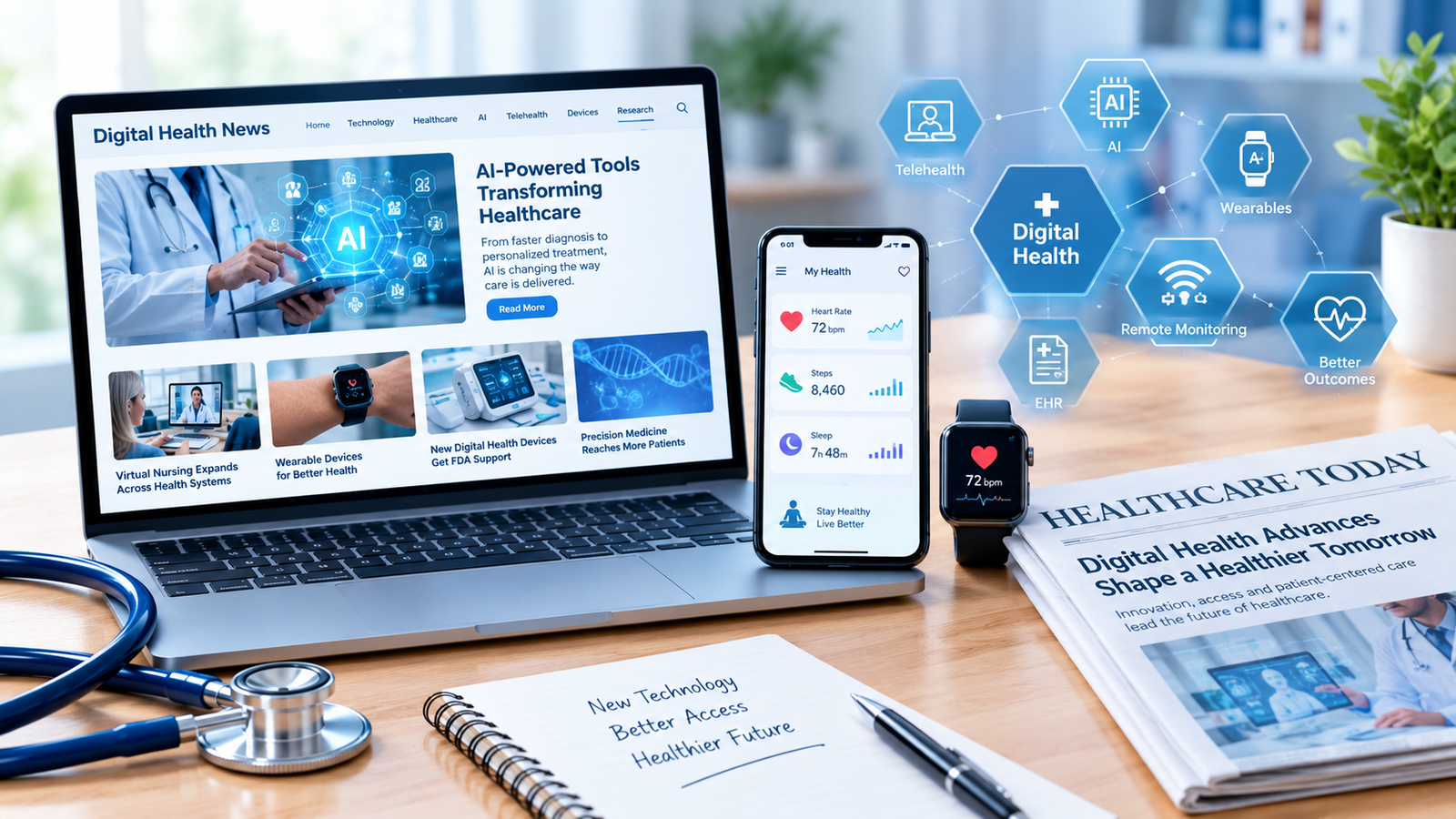

Digital health continues to move quickly as healthcare organizations adopt artificial intelligence, virtual care, connected devices, electronic health systems and new tools for remote patient monitoring. Digital health news today is no longer limited to experimental technology. Many developments now involve products and services being introduced into real healthcare settings.
As of October 5, 2026, several developments are attracting attention across the digital health sector. Current coverage includes AI-powered healthcare tools, virtual nursing, digital medical devices, precision medicine and new approaches to regulating artificial intelligence.
This article looks at the most relevant developments and explains what they could mean for patients, healthcare professionals and the wider industry.
Table of Contents
Latest Digital Health Developments Today
AI Powered Healthcare Tools Continue to Expand
Artificial intelligence remains one of the biggest themes in healthcare technology. AI is being used for medical imaging, clinical decision support, administrative tasks, patient monitoring and research.
Current industry coverage on October 5 includes developments involving AI-powered breast cancer detection, healthcare AI partnerships and new leadership focused on artificial intelligence at major healthcare technology companies.
The expansion of AI does not mean that every tool is ready to replace clinical professionals. Instead, many systems are designed to support healthcare workers by processing information, identifying patterns or helping with specific tasks.
The U.S. Food and Drug Administration’s digital health resources provide information about AI-enabled medical devices and their role within regulated healthcare technology.
Virtual Nursing Is Getting More Attention
Virtual nursing is another area appearing in current healthcare technology coverage. Digital systems can allow nurses to support patients remotely while working alongside staff who are physically present in hospitals or other care environments.
Current industry reporting on October 5 highlights an expansion of virtual nursing involving Optum and Owensboro Health.
Virtual nursing can potentially help healthcare organizations use clinical expertise more efficiently. Depending on the implementation, remote nurses may support patient education, documentation, monitoring and communication.
The technology does not remove the need for nurses at the bedside. Instead, the goal is often to create a connected care model where remote and in-person teams work together.
FDA and Digital Health Regulation
Regulation is becoming increasingly important as digital healthcare products become more sophisticated.
The FDA announced in July 2026 that it had selected the first participant for its TEMPO for Digital Health Devices Pilot. The program is designed to explore a regulatory approach for certain digital health devices while generating real-world evidence about their impact on health outcomes.
This is significant because healthcare technology needs to demonstrate more than technical performance. Developers and regulators also need to consider whether a technology can provide meaningful benefits for patients in real-world settings.
The FDA also announced a 2026 funding opportunity focused on studying digital health technologies such as actigraphy, photography and contactless sensors in drug development.
AI Medical Devices and Clinical Evidence
AI-enabled medical devices are becoming a major part of the healthcare technology landscape. These devices can support tasks such as image analysis, monitoring and clinical decision-making.
However, approval or clearance does not automatically mean that a technology will improve every patient’s outcome. Healthcare organizations still need to consider accuracy, usability, clinical context, privacy and appropriate human oversight.
This is why evidence and regulation remain important parts of the digital health discussion. The FDA maintains a public list of AI-enabled medical devices that provides a useful reference for understanding how AI is being incorporated into regulated medical products.
Digital Health and Precision Medicine
Precision medicine is another area where digital technology is making an impact. Modern healthcare systems can combine information from medical records, diagnostic tests, imaging and other sources to support more personalized approaches to care.
Current digital health coverage on October 5 includes developments around precision medicine and healthcare technology partnerships in India.
The broader idea is to move away from a one-size-fits-all approach when reliable information allows treatment or prevention strategies to be better matched to individual patients.
Technology can support this process, but clinical expertise remains essential when interpreting patient information and making healthcare decisions.
Wearable Devices and Remote Monitoring
Wearable technology has become another important part of digital healthcare. Smart watches, sensors and connected medical devices can collect information such as activity, heart rate and other health-related measurements.
Remote monitoring can be particularly useful for managing some chronic conditions because information may be collected outside traditional clinical settings.
The FDA’s digital health framework includes technologies that can collect and process health information for different healthcare purposes.
For patients, the biggest potential advantage is convenience. Instead of relying only on occasional appointments, certain digital systems can provide healthcare professionals with additional information collected between visits.
Why Digital Health News Matters
Following digital health news today can help people understand how healthcare is changing. Technology can affect everything from how patients communicate with providers to how hospitals monitor patients and how researchers develop new treatments.
For healthcare professionals, digital tools can create opportunities to reduce repetitive administrative work and improve access to information.
For patients, digital healthcare may offer greater convenience, remote access and more personalized services. At the same time, new technology creates questions about privacy, security, accuracy and responsible use.
The World Health Organization describes digital health as an important part of strengthening health systems and continues to work on digital health transformation and responsible artificial intelligence in healthcare.
Privacy and Security Remain Important
More connected healthcare systems also mean more health information is being processed digitally. This makes cybersecurity and privacy important considerations.
Healthcare organizations need safeguards for patient information and clear policies around who can access data and how it can be used.
The issue becomes even more important when AI systems are connected to clinical workflows. Recent reporting has highlighted concerns about unauthorized AI tools being used within healthcare organizations without formal IT approval.
This shows why adopting new technology should involve governance and security from the beginning rather than treating them as an afterthought.
Digital Health and Everyday Wellness
Digital healthcare is not limited to hospitals and medical devices. Apps, connected platforms and online resources are also changing how people learn about nutrition and wellness.
Nutravyntra focuses on nutrition and healthy living, including practical guidance around food and everyday habits. Its guide to Most Nutrient Dense Foods explains how nutrient density can help people think about food quality beyond calories alone.
Digital tools can make this type of information easier to access, but people should still consider the quality and reliability of health information before making significant changes to their health routine.
What to Watch Next
Several areas are likely to remain important throughout 2026.
AI regulation will continue developing as healthcare organizations experiment with increasingly advanced systems. Digital medical devices will also need stronger evidence showing how they perform in real-world settings.
Virtual care and remote monitoring are likely to remain relevant as healthcare providers look for ways to improve access and manage growing demand.
Another important area will be responsible AI. Healthcare technology needs to balance innovation with patient safety, privacy, transparency and human oversight.
Frequently Asked Questions
What is digital health?
Digital health refers to the use of digital technologies to support healthcare and wellbeing. It can include telehealth, health apps, electronic health records, wearable devices, remote monitoring and artificial intelligence.
What are the biggest digital health trends in 2026?
AI in healthcare, virtual care, remote monitoring, digital medical devices, precision medicine and healthcare cybersecurity are among the major areas receiving attention in 2026.
How is AI being used in healthcare?
AI can support medical imaging, data analysis, clinical decision support, research and administrative workflows. Its role depends on the specific technology and healthcare setting.
Is digital healthcare safe?
Digital healthcare can provide valuable benefits, but safety depends on the technology, evidence, security measures and appropriate clinical oversight.
Why is digital health important?
Digital health can improve access to information and services while helping healthcare organizations manage data and deliver care in new ways.
Will digital health replace doctors and nurses?
Most digital health technologies are designed to support healthcare professionals rather than completely replace them. Human judgment remains important for many healthcare decisions.
Conclusion
Digital health news today shows a healthcare industry that is moving rapidly toward connected technologies, artificial intelligence, virtual care and data-driven services. Current developments on October 5, 2026 include new AI applications, virtual nursing expansion, digital health regulation and continued investment in precision medicine.
The most important question is not simply how advanced a technology is. It is whether that technology can improve healthcare safely, responsibly and meaningfully.
As digital health continues to develop, patients and healthcare professionals will need reliable information, strong privacy protections and appropriate human oversight alongside technological innovation.