

Last updated: October 21, 2026. This article is for general education. Information is checked against MedlinePlus, RadiologyInfo and National Cancer Institute resources.
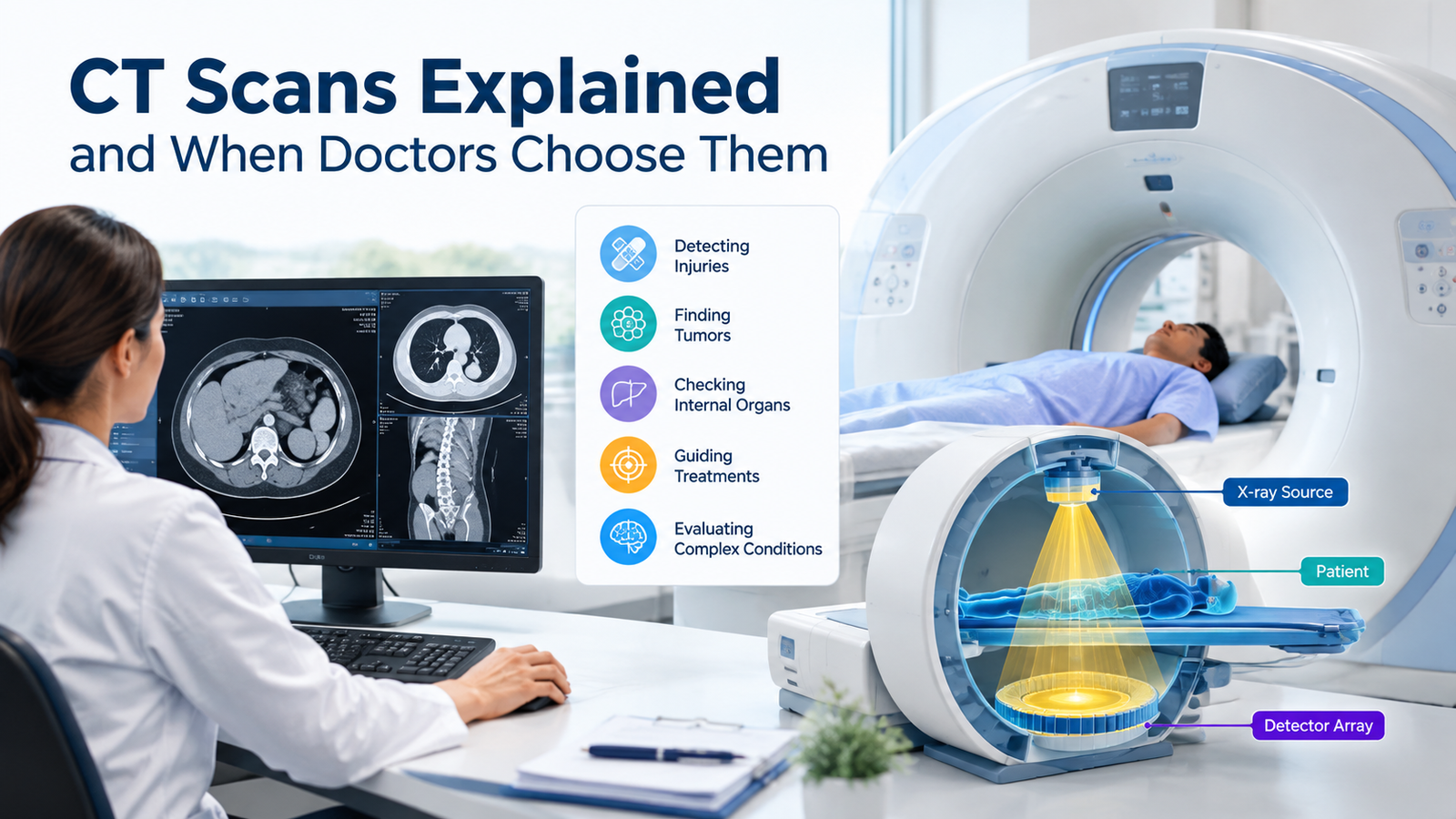
CT stands for computed tomography. A CT scan is an imaging test that takes detailed pictures inside the body in a few minutes. It helps doctors find injuries, infections, tumors and blood vessel problems. If your doctor has asked for one, you may wonder what the test shows and what it feels like.
This guide answers the questions people ask most. It explains what CT means, the most common reasons for a scan, what it can detect, how long it takes, what it costs and how to read your report. It does not replace advice from a clinician who knows your health history.
| Fact | Detail |
|---|---|
| Full form | Computed tomography (also called a CAT scan) |
| How it works | X rays from many angles combined by a computer |
| Scan time on the table | About 5 to 10 minutes |
| Full visit | Often 30 to 60 minutes or more |
| Is it painful | No, the scan itself is painless |
| Main risks | Small radiation dose and rare contrast reactions |
| Results | Usually reach your doctor within a day |
What Does CT Scan Stand For and What Is It
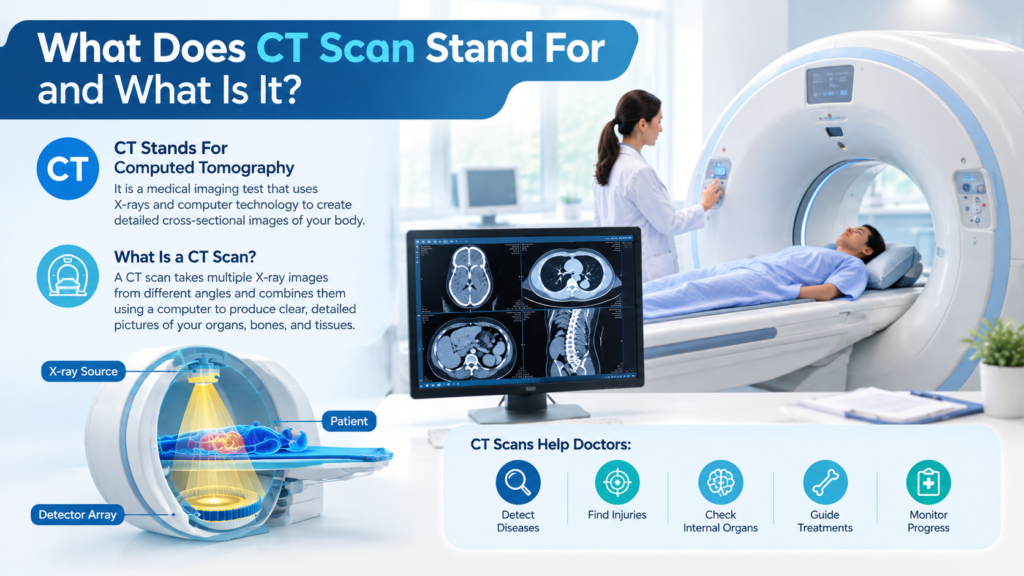
CT stands for computed tomography. The test is also called a CAT scan, from the older term computerized axial tomography. It uses X rays taken from many angles and a computer that combines them into detailed cross-section pictures of the body.
A regular X ray gives a flat image where structures overlap. A CT scan works more like slicing a loaf of bread and looking at each slice. This lets doctors see organs, bones, blood vessels and soft tissue in much clearer detail.
How a CT Scanner Works
You lie on a table that slides through a large ring-shaped machine. Inside the ring an X ray tube rotates around you and detectors measure how much radiation passes through the body. A computer turns those measurements into images that a radiologist can scroll through slice by slice.
The machine is open and quieter than an MRI. You may hear soft whirring or clicking. A technologist watches from the next room and can speak with you through an intercom the whole time.
Contrast Dye Explained
Some scans use a contrast material that helps certain tissues and blood vessels show up more clearly. It may be given through a vein, taken as a drink or both. Many people feel a warm flush or a metallic taste for a short time after an injection.
Tell the staff about allergies, kidney disease, pregnancy and any diabetes medicines before the scan. Serious reactions are rare and the team is trained to manage them. Not every scan needs contrast, and your doctor will decide based on the question being asked.
What Is the Most Common Reason for a CT Scan
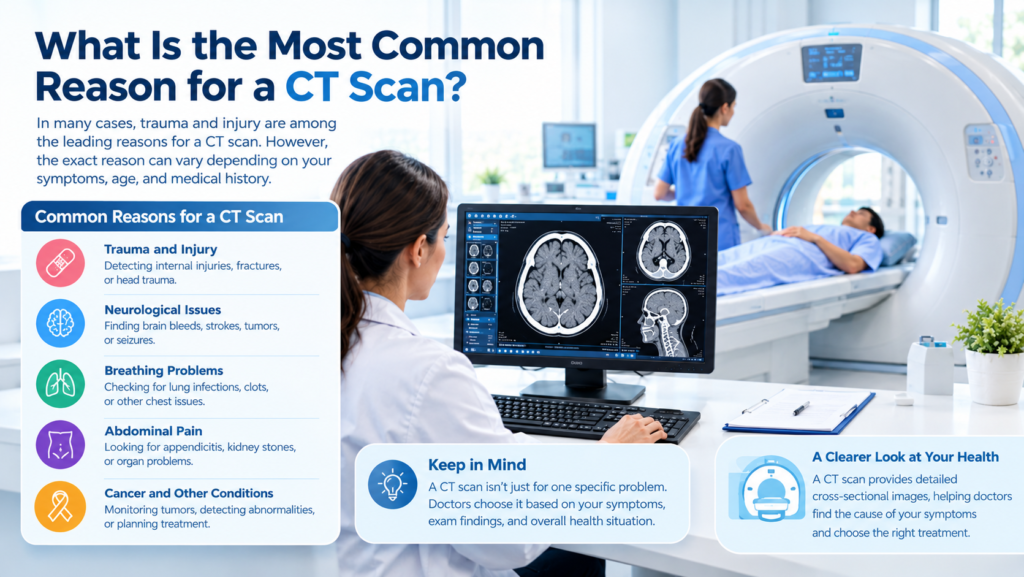
No single reason fits every country or hospital. In emergency care, doctors often order CT scans after head injuries and accidents and for sudden severe belly pain. Outside the emergency room, common reasons include checking for cancer and following known tumors over time.
| Situation | Why CT is chosen |
|---|---|
| Head injury | Fast check for bleeding or skull fracture |
| Severe abdominal pain | Looks for appendicitis, kidney stones and blockages |
| Chest pain or shortness of breath | Checks the lungs and blood vessels for clots or other problems |
| Cancer diagnosis and follow-up | Shows tumor size and spread |
| Major accident | Finds internal injuries quickly |
| Stroke symptoms | Rules out bleeding in the brain |
Emergency Room Uses
Speed is the main strength of CT in emergencies. A scan takes minutes and gives doctors a clear picture of bleeding, fractures and organ injury. This can guide urgent decisions about surgery and treatment.
Cancer Care and Screening
CT scans help doctors measure tumors, see whether cancer has spread and check how well treatment is working. Low-dose CT is used to screen certain older adults with a heavy smoking history for lung cancer. Screening is not right for everyone, and doctors follow national guidelines when deciding who should be offered it.
What Can CT Scans Detect
CT scans are especially good at showing bones, lungs, bleeding and many types of tumors. They can also show infections, blockages and changes in blood vessels. A scan does not find every condition, and doctors combine results with symptoms and other tests.
| Body area | Examples of what CT can help find |
|---|---|
| Head and neck | Bleeding, fractures, sinus disease and some tumors |
| Chest | Lung nodules, pneumonia, blood clots and aortic problems |
| Abdomen and pelvis | Appendicitis, kidney stones, tumors and abscesses |
| Bones and spine | Complex fractures, joint problems and spinal changes |
| Blood vessels | Aneurysms, narrowing and clots |
Head and Neck
A head CT is often used after an injury or when someone has a sudden severe headache or stroke symptoms. It can show bleeding, swelling and fractures within minutes. For detailed views of brain tissue an MRI may be better.
Chest and Heart
Chest CT is useful for lung disease and for finding blood clots in the lungs. It can show small nodules that a standard chest X ray may miss. A heart CT can measure calcium in the coronary arteries, which helps assess heart disease risk. CT angiography uses contrast to show blood vessels in detail.
Abdomen and Pelvis
Abdominal CT is a common test for unexplained belly pain. It can show appendicitis, kidney stones, inflammation, abscesses and many tumors. Preparation may include fasting for a few hours and drinking oral contrast, so follow your imaging center’s instructions closely.
Bones and Blood Vessels
CT shows bone detail very well and is used for complex fractures, joint problems and some spine conditions. It can also guide procedures such as biopsies. For blood vessels, CT angiography gives a quick map of arteries and veins.
CT Scan Versus MRI in Brief
CT uses X rays and is fast, which makes it the usual choice for emergencies, bones, lungs and bleeding. MRI uses magnets and radio waves and shows soft tissue such as the brain, spinal cord and ligaments in more detail. MRI takes longer and does not use radiation. For a full side-by-side guide, read our CT scan vs MRI comparison.
How Long Does a CT Scan Take
The scan itself is fast. Most CT scans take about 5 to 10 minutes on the table, and the actual imaging is often only a few seconds to a minute. The whole visit takes longer because of forms and preparation.
| Step | Typical time |
|---|---|
| Check-in and forms | 10 to 20 minutes |
| Changing and preparation | 5 to 15 minutes |
| Placing an IV if contrast is used | 5 to 10 minutes |
| Scanning | 5 to 10 minutes |
| Short observation after contrast | Up to 30 minutes |
Before the Scan
You may be asked to avoid food for a few hours and to drink water or oral contrast. Remove jewelry and metal items and wear comfortable clothing. Tell the staff about allergies, medicines and kidney problems. Drinking oral contrast can take an hour or more, so arrive a little early.
During the Scan
You lie still on the table while it moves through the ring. You may be asked to hold your breath for a few seconds. If contrast is injected you may feel warmth and a metallic taste that passes quickly. The technologist can see and hear you throughout, so speak up if you feel uncomfortable.
After the Scan
Most people go back to normal activities right away. If you had contrast, drinking extra water helps flush it out unless your doctor has told you to limit fluids. Report any rash, swelling or trouble breathing to the staff or a doctor immediately.
CT Scan Price and What Affects It
CT scan prices vary widely. In the United States, costs can range from a few hundred dollars at a standalone imaging center to several thousand dollars at a hospital. Prices in other countries depend on the city, the facility and the type of scan. Ask the imaging center for a written estimate before the scan and ask what is included.
| Factor | How it affects the price |
|---|---|
| Body area | Larger or more complex scans cost more |
| Contrast | Adds the cost of the material and staff time |
| Facility type | Hospitals often charge more than imaging centers |
| Location | Big cities and some regions cost more |
| Urgency | Emergency scans can cost more |
| Insurance | Coverage and network status change what you pay |
Insurance and Payment
Insurance often covers medically necessary CT scans, but you may still pay a deductible or a share of the cost. Check whether the imaging center is in your network and whether your plan needs prior approval. If you pay out of pocket, ask about cash prices and payment plans.
Ways to Lower Cost Safely
Compare a few facilities and ask your doctor whether an imaging center is suitable. Do not skip or delay a scan only because of cost when your doctor says it is needed. Avoid repeat scans by bringing earlier images and reports to new appointments.
How to Read a CT Scan Report
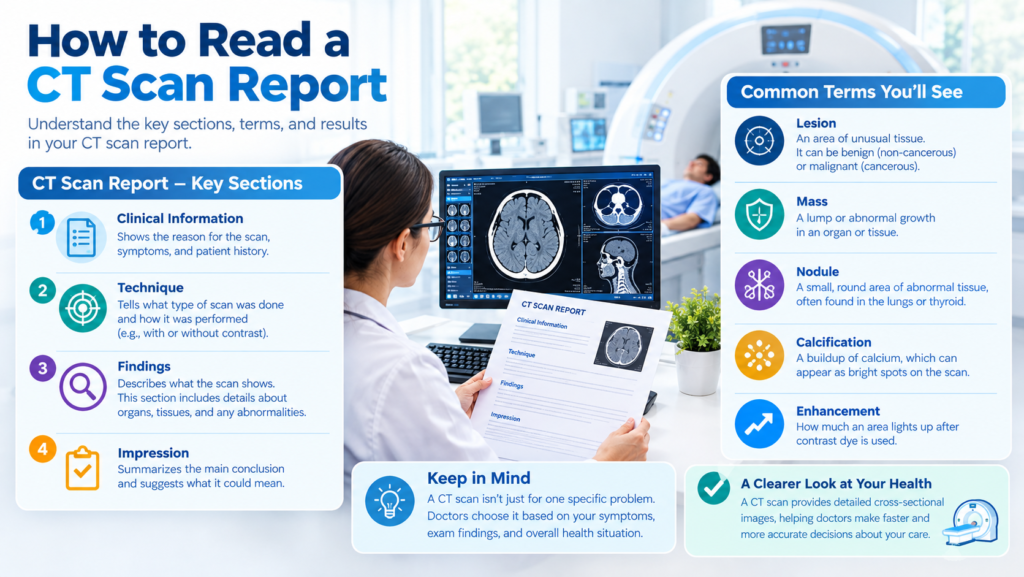
A radiologist reviews the images and writes a report for your doctor. It usually includes the reason for the scan, the technique, a comparison with earlier images, the findings and an impression. The impression is a short summary and is the part most doctors read first.
Reports use technical language. A phrase that sounds worrying may be harmless, and a normal-sounding phrase may still need follow-up. Your doctor connects the report with your symptoms.
| Term | What it usually means |
|---|---|
| Unremarkable | Nothing abnormal was seen |
| Stable | No change compared with earlier scans |
| Incidental finding | Something unrelated to the reason for the scan |
| Nodule | A small spot that may need follow-up |
| Lesion | An area that looks different from normal tissue |
| Cyst | A fluid-filled sac, often harmless |
| Recommend correlation | The doctor should compare with symptoms or other tests |
Common Terms Explained
Words like nodule, cyst and lesion describe how something looks, not a diagnosis. Most small cysts and nodules are harmless, but some need follow-up scans. Trusted sources such as MedlinePlus explain imaging tests in plain language.
What to Do With Your Report
Do not rely on search results to interpret your scan. Book a visit with your doctor to go through the findings. Write down questions about next steps and ask for a copy of the report and images. If you are unsure whom to see first, ask your primary care clinician, who can guide you to the right specialist.
Are CT Scans Safe
CT scans are generally safe, and the benefits usually outweigh the risks when a scan is medically needed. The main concerns are radiation exposure and reactions to contrast material. Doctors try to use the lowest dose that gives a clear answer.
Radiation Dose
A CT scan uses more radiation than a standard X ray. The added cancer risk from one scan is small, but it can add up with many scans. No radiation stays in your body after the test. Tell your doctor about earlier scans. Children and pregnant women need special care, and doctors often choose other tests when they can.
Contrast Dye and Kidney Health
Contrast material is usually well tolerated. Rarely it can cause an allergic reaction or affect the kidneys, so people with kidney disease, diabetes or past contrast reactions need extra planning. The team may check kidney function with a blood test first. If you take metformin, ask whether you need to pause it.
Latest Update on CT Scans
CT technology keeps improving. Newer scanners and software aim to lower radiation dose while keeping images clear. Artificial intelligence tools are also being used to help radiologists review scans, but they support doctors rather than replace them. Always ask your care team which type of scan and dose are right for you.
When to Talk With a Doctor About a CT Scan
Ask your doctor why a scan is needed and what the result will change. Good questions include whether another test could answer the same question, whether contrast is needed and how you will get results. Bring earlier scans and reports so your doctor can compare them.
Seek urgent care for sudden severe pain, head injury, stroke symptoms or trouble breathing. Do not wait for a scan appointment.
Pros and Cons of CT Scans
| Pros | Cons |
|---|---|
| Fast, often a few minutes | Uses a small dose of radiation |
| Clear detail of bones, lungs and bleeding | Contrast can rarely cause reactions |
| Widely available, including emergencies | Less soft tissue detail than MRI |
| Painless and noninvasive | Cost can be high at hospitals |
Frequently Asked Questions
What does CT scan stand for?
CT stands for computed tomography. It is also called a CAT scan, short for computerized axial tomography.
What is the most common reason for a CT scan?
There is no single answer. Common reasons include head injuries, belly pain, chest problems and cancer follow-up.
How long does a CT scan take?
The scan itself usually takes about 5 to 10 minutes. The full visit often lasts 30 to 60 minutes or more.
What can CT scans detect?
They can detect bleeding, fractures, infections, tumors, blood clots and many organ problems.
Is a CT scan better than an MRI?
Neither is always better. CT is faster and good for bones and emergencies, while MRI shows soft tissue in more detail.
How much does a CT scan cost?
Cost varies by country, facility and scan type. Ask for a written estimate before the test.
Is a CT scan painful?
No. You may feel a small pinch if an IV is placed and a brief warm feeling with contrast.
How soon do I get CT scan results?
Results often reach your doctor within a day. Urgent scans are read much faster.
Final Thoughts
CT scans give doctors a fast, detailed look inside the body and help them make safe decisions. Knowing what CT stands for, what it shows and how to read the report makes the process less stressful. Follow preparation steps, ask questions and review your report with a doctor.