
Quick answer: Moong dal protein per 100g is about 24 to 27 g when dry and about 7 to 8 g when cooked. Whole green moong has about 24 g of protein and 16 g of fiber per 100 g dry, so one katori of cooked moong dal usually gives 7 to 12 g of protein.
Moong dal is one of the lightest and most loved dals in desi kitchens. It cooks fast, is gentle on the stomach, and turns into everything from simple dal tadka and khichdi to chilla and sprouts chaat.
This guide explains moong dal protein per 100 g dry and cooked, split vs whole moong, sprouts, protein in common portions like 1 katori and 1 chilla, moong dal vs chana, soya and paneer, benefits, how much to eat and high protein moong dal ideas.
Table of Contents
Moong Dal Nutrition per 100g
| Per 100 g | Whole green moong, dry | Moong dal (split, yellow), dry | Whole moong, boiled | Moong dal, boiled |
|---|---|---|---|---|
| Calories | 347 kcal | 291 kcal | 105 kcal | 92 kcal |
| Protein | 23.9 g | 27 g | 7 g | 7.8 g |
| Fat | 1.2 g | 1.1 g | 0.4 g | 0.4 g |
| Carbohydrates | 62.6 g | Not listed | 19.2 g | Not listed |
| Fiber | 16.3 g | Lower (husk removed) | About 6 g | Lower |
| Iron | 6.7 mg | Not listed | Not listed | Not listed |
Whole moong values (dry and boiled) are from USDA FoodData Central. Split moong dal values, and the fiber for boiled whole moong, are from the UK government’s McCance and Widdowson’s Composition of Foods (CoFID 2021). Different databases and brands give slightly different numbers (for example, calories for dry moong range from about 280 to 350 kcal per 100 g depending on the source), so a protein range of about 24 to 27 g is realistic. Check the label on your own pack.
Why cooked dal has less protein per 100 g: dal absorbs a lot of water while cooking and becomes about 3 times heavier. The protein stays the same, it is just spread over more weight. Thin, watery dal has even less protein per katori than thick dal.
Moong Dal Protein in Common Portions
| Portion | Protein (about) | Calories (about) |
|---|---|---|
| 30 g dry moong dal (enough for 1 small bowl) | 7 to 8 g | 87 to 104 kcal |
| 50 g dry moong dal | 12 to 13.5 g | 146 to 174 kcal |
| 100 g dry moong dal | 24 to 27 g | 291 to 347 kcal |
| 1 katori cooked moong dal (about 150 g) | 7 to 12 g, depending on thickness | About 140 to 160 kcal, plus tadka oil or ghee |
| 1 cup boiled whole moong (202 g) | 14 g | 212 kcal |
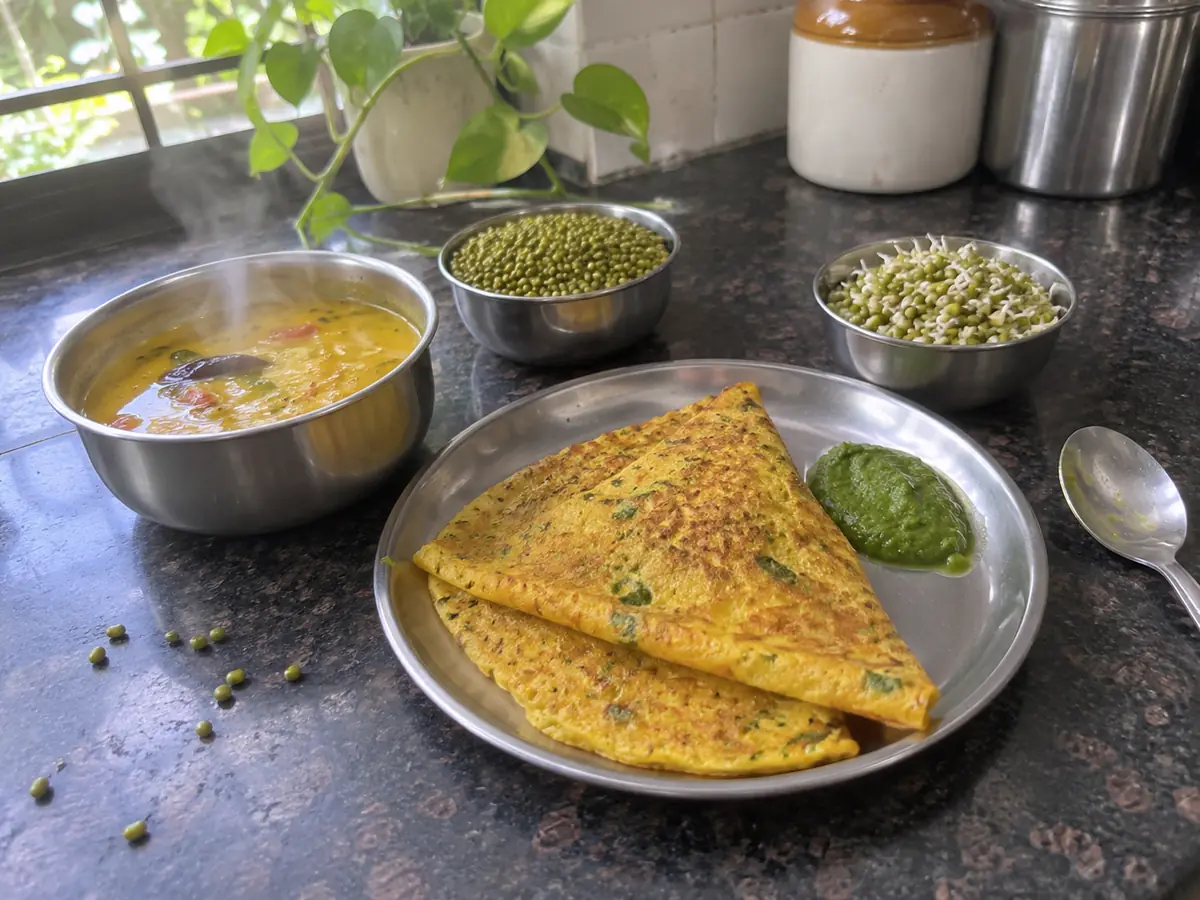
| 1 moong dal chilla (from about 40 g dry dal) | About 10 g | About 120 to 140 kcal, plus oil |
Katori sizes and dal thickness vary a lot, so for accurate tracking weigh the dry dal before cooking.
Whole Moong vs Moong Dal vs Sprouts
- Whole green moong (sabut moong): the full bean with its green skin. About 24 g protein and 16 g fiber per 100 g dry. The skin makes it much higher in fiber and slower to digest.
- Yellow moong dal (dhuli moong): split and skinned. Slightly higher protein per 100 g dry (about 24 to 27 g) because the husk is gone, but lower in fiber. It cooks fastest and is the easiest to digest.
- Green moong dal (chilka moong): split with the skin on, in between the two.
- Sprouted moong: sprouting adds a lot of water. Long, shop-style bean sprouts have only about 3 g of protein per 100 g, according to USDA. Home-sprouted moong with short tails is denser, so it has more protein per 100 g, but still less than dry moong. Weigh the moong dry before soaking if you want exact numbers.
Moong Dal vs Chana vs Soya vs Paneer
Per 100 g, approximate values from USDA, CoFID and brand labels.
| Food (100 g) | Protein | Calories | Fat |
|---|---|---|---|
| Soya chunks, dry | About 52 g | About 345 kcal | Less than 1 g |
| Chicken breast, cooked | About 29 g | About 151 kcal | About 3.6 g |
| Moong dal, dry | About 24 to 27 g | About 291 to 347 kcal | About 1 g |
| Chana, dry | About 20.5 g | About 378 kcal | About 6 g |
| Paneer | About 20 g | About 323 kcal | About 25 g |
| Whole eggs (about 2 eggs) | About 12.5 g | About 143 kcal | About 9.5 g |
| Moong dal, cooked | About 7 to 8 g | About 92 to 105 kcal | Less than 1 g |
- Dry moong dal has more protein than dry chana and paneer per 100 g, with very little fat.
- Soya chunks still have about twice as much. See soya chunks protein per 100g.
- For more comparisons, read chana protein per 100g and paneer protein per 100g.
Is Moong Dal a Complete Protein?
Not on its own. Like other dals, moong is low in one essential amino acid (methionine). Eating it with rice or roti, as in dal chawal, khichdi or dal roti, gives all the essential amino acids. These foods do not have to be in the same meal; a mix of foods over the day works too. To understand amino acids and complete protein simply, read protein meaning in Hindi.
Health Benefits of Moong Dal
- Good plant protein with very little fat: about 1 g of fat per 100 g dry.
- Light on the stomach: yellow moong dal and khichdi are a common choice when people are unwell or want a light meal. Many people find it easier to digest than heavier dals like rajma or chole.
- High in fiber (whole moong): about 16 g per 100 g dry supports digestion and keeps you full. See our high fiber breakfast foods for more ideas.
- Source of iron: whole moong has about 6.7 mg of iron per 100 g dry. Eating it with vitamin C foods like lemon or tomato helps the body absorb plant iron.
- Budget friendly and quick to cook: yellow moong dal cooks in about 15 to 20 minutes in a pot, or 2 to 3 whistles in a pressure cooker.
How Much Moong Dal Can You Eat in a Day?
For most healthy adults, 1 to 2 katori of cooked moong dal a day (about 30 to 60 g dry) is a sensible amount. That gives roughly 7 to 16 g of protein.
According to the ICMR-NIN Nutrient Requirements for Indians (2020), healthy adults need about 0.83 g of protein per kg of body weight per day, which is about 54 g for a 65 kg man and 46 g for a 55 kg woman. Moong dal can cover a good part of this, along with curd, paneer, eggs, chana or soya.
Side Effects and Tips
- Gas or bloating: whole moong and sprouts can cause gas in some people. Soak well, rinse, cook fully and increase portions slowly. Yellow moong dal is usually the gentlest.
- Raw sprouts: sprouts can carry germs. Buy or make them fresh, keep them in the fridge, and wash them well. Children, older adults, pregnant women and anyone with weak immunity should eat sprouts only after cooking them thoroughly.
- Watch the tadka: lots of ghee or oil can double the calories of a bowl of dal.
- Kidney disease or a protein-restricted diet: ask your doctor how much dal is right for you.
Moong Dal for Weight Loss and Gym
Weight loss: moong dal is high in protein, low in fat and filling, especially as a thick dal or chilla. Keep the tadka light and pair it with vegetables and a small portion of rice or roti.
Muscle building: a thick bowl of dal gives a moderate amount of protein, so combine it with higher protein foods such as paneer, curd, eggs or soya, for example moong dal chilla stuffed with paneer. For more ideas, see our high protein snacks for weight loss.
High Protein Moong Dal Ideas
| Idea | Why it works |
|---|---|
| Moong dal chilla with paneer | About 10 g protein from the chilla plus more from the paneer filling |
| Thick moong dal with less water | More protein per katori than thin, watery dal |
| Moong dal khichdi with vegetables | Dal plus rice gives complete protein, light and filling |
| Sprouted moong chaat | Fresh and crunchy, add onion, tomato, cucumber and lemon |
| Whole moong curry (sabut moong) | More fiber than yellow dal, great with roti |
| Moong dal in soup | Add a handful of dal to vegetable soup for extra protein |
Moong Dal Protein per 100g in Hindi
100 ग्राम सूखी मूंग दाल में लगभग 24 से 27 ग्राम प्रोटीन होता है। साबुत हरी मूंग में 100 ग्राम में लगभग 24 ग्राम प्रोटीन, 347 कैलोरी और 16 ग्राम फाइबर होता है। पकाने के बाद दाल पानी सोखकर लगभग 3 गुना भारी हो जाती है, इसलिए 100 ग्राम पकी मूंग दाल में लगभग 7 से 8 ग्राम प्रोटीन रहता है। एक कटोरी (लगभग 150 ग्राम) पकी मूंग दाल में दाल के गाढ़ेपन के हिसाब से 7 से 12 ग्राम प्रोटीन होता है, और लगभग 40 ग्राम दाल से बने एक मूंग दाल चीले में करीब 10 ग्राम प्रोटीन होता है। मूंग दाल को चावल या रोटी के साथ खाने से प्रोटीन पूरा होता है। ज़्यादातर स्वस्थ लोग रोज़ 1 से 2 कटोरी मूंग दाल खा सकते हैं।
| मूंग दाल | प्रोटीन | कैलोरी |
|---|---|---|
| 100 ग्राम सूखी मूंग दाल | लगभग 24 से 27 ग्राम | लगभग 291 से 347 |
| 100 ग्राम पकी मूंग दाल | लगभग 7 से 8 ग्राम | लगभग 92 से 105 |
| 1 कटोरी पकी मूंग दाल | लगभग 7 से 12 ग्राम | लगभग 140 से 160 (तड़के के बिना) |
| 1 मूंग दाल चीला | लगभग 10 ग्राम | लगभग 120 से 140 |
Frequently Asked Questions
How much protein is in 100g of moong dal?
About 24 to 27 g in 100 g of dry moong dal, and about 7 to 8 g in 100 g of cooked moong dal.
How much protein is in 100g of cooked moong dal?
About 7 to 8 g, because cooked dal absorbs water and becomes about 3 times heavier.
How much protein is in 1 katori of moong dal?
About 7 to 12 g in a katori of about 150 g of cooked moong dal. Thick dal has more, watery dal has less.
How much protein is in green moong (sabut moong)?
About 24 g per 100 g dry and about 7 g per 100 g boiled, according to USDA. One cup of boiled whole moong (202 g) has about 14 g.
How much protein is in moong sprouts?
Long, shop-style bean sprouts have about 3 g per 100 g. Home-sprouted moong with short tails has more, but less than dry moong because sprouting adds water.
How much protein is in 1 moong dal chilla?
About 10 g in a chilla made from about 40 g of dry moong dal. Adding paneer or curd raises it further.
Which has more protein, moong dal or chana?
Per 100 g dry, moong dal has a little more (about 24 to 27 g) than chana (about 20.5 g), and much less fat.
Is moong dal good for weight loss?
Yes. It is high in protein, low in fat and filling. Keep the tadka light and avoid adding too much ghee.
Is moong dal a complete protein?
Not by itself. Eat it with rice or roti, as in khichdi or dal chawal, to get all the essential amino acids.
Can I eat moong dal every day?
Yes. Most healthy adults can eat 1 to 2 katori of cooked moong dal a day as part of a varied diet.
मूंग दाल में कितना प्रोटीन होता है?
100 ग्राम सूखी मूंग दाल में लगभग 24 से 27 ग्राम और 100 ग्राम पकी मूंग दाल में लगभग 7 से 8 ग्राम प्रोटीन होता है।
Final Thoughts
Moong dal protein per 100g is about 24 to 27 g dry and 7 to 8 g cooked, with very little fat. Whole green moong adds lots of fiber and iron, while yellow moong dal is the lightest to digest. Make your dal a little thicker, keep the tadka light, pair it with rice or roti, and add chilla, sprouts or paneer to push your protein higher.
This article is for general information and does not replace advice from a doctor or registered dietitian.