

Last updated October 13 2026
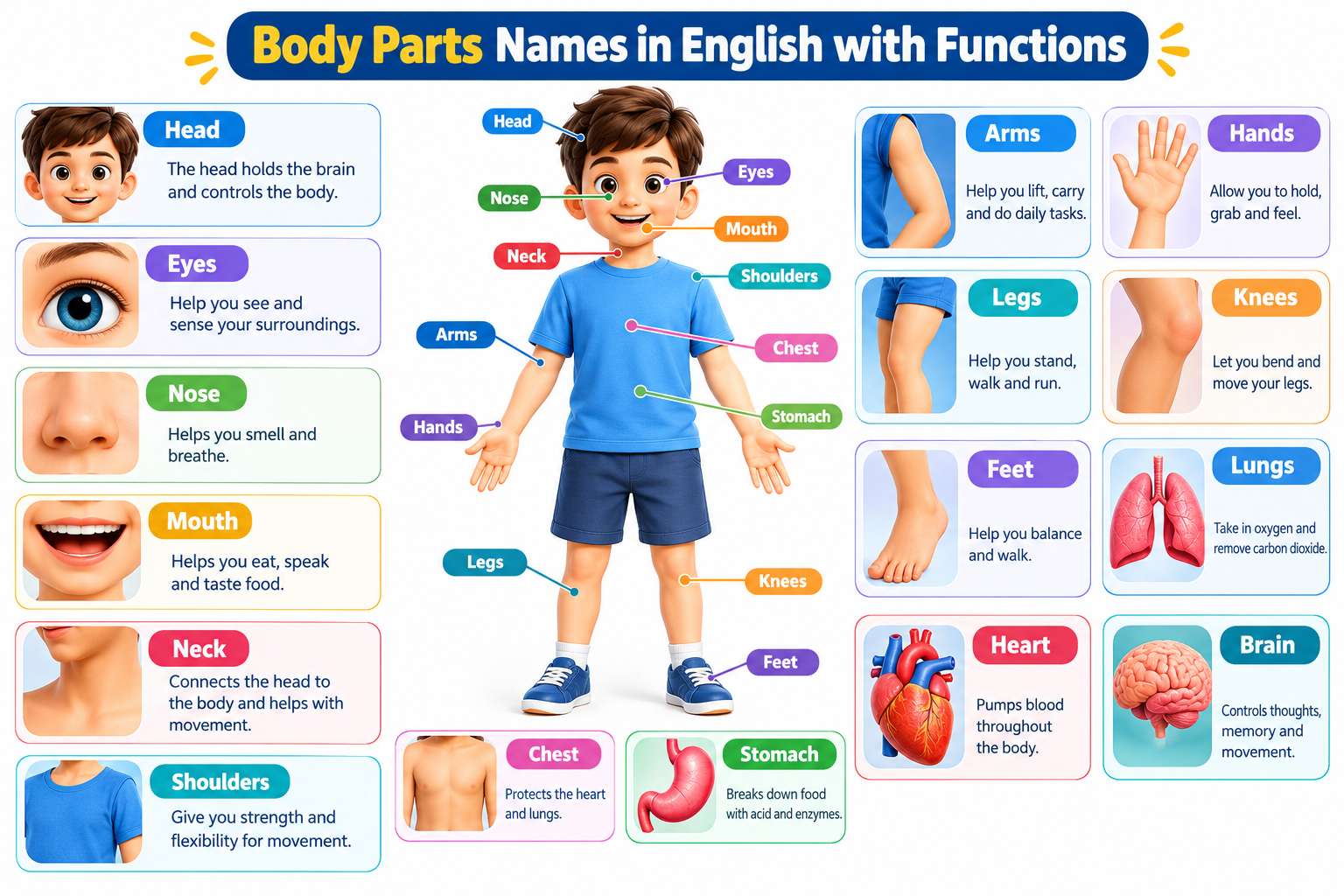
Body parts names are the words we use for each region and organ of the human body. They cover parts you can see such as the head and hands and feet and parts inside such as the heart and lungs. Knowing them helps at school and at home and when you need to tell a doctor where it hurts.
Quick answer. The main external parts are the head and neck and shoulders and arms and hands and chest and back and abdomen and legs and feet. The main internal parts are the brain and heart and lungs and liver and stomach and kidneys and intestines. An adult body also has 206 bones and hundreds of muscles that support and move these parts.
This guide gives a clear list of 50 body parts in English and explains what each one does. It covers external parts and internal organs and female anatomy and body systems. It also shows how to learn the names with pictures and how to avoid common mix ups. The information is educational and does not replace advice from a doctor.
Why these names matter
Children learn these words early in school and at home. English learners use them to build basic vocabulary. Patients use them to describe where it hurts and parents use them to talk about health with their kids. Health workers and biology students rely on exact names so that everyone understands each other clearly.
Each part also has a job. Some help us move and some help us think or breathe or digest food. Together they work as one connected system.
Main areas of the human body
The body is usually divided into a few large regions. This makes it easier to remember where each part sits.
| Region | Main parts it includes |
|---|---|
| Head | Face and skull and brain and eyes and ears and nose and mouth |
| Neck | Throat and neck muscles and the top of the spine |
| Trunk | Chest and back and abdomen and waist and hips |
| Upper limbs | Shoulders and arms and elbows and wrists and hands and fingers |
| Lower limbs | Thighs and knees and legs and ankles and feet and toes |
The head sits on the neck and the neck joins the trunk. The arms attach at the shoulders and the legs attach at the hips. Doctors use these regions to describe pain or injury so knowing the names along the arm or leg makes a symptom much easier to explain.
Common body part names list in English
This list covers fifty of the most common body parts in English. It is grouped by region so that it is easy to study. Each table gives the name and a short note on what it does.
Head and face
The head holds the brain and most of the sense organs. The face is the front part of the head and includes the eyes and nose and mouth. These parts help us see and hear and smell and taste and speak.
| Body part | What it does |
|---|---|
| Head | Holds the brain and sense organs |
| Hair | Protects the scalp and helps regulate warmth |
| Forehead | Upper part of the face |
| Eyebrow | Helps keep sweat and dust out of the eyes |
| Eye | Allows us to see |
| Ear | Allows hearing and helps balance |
| Nose | Used for smell and breathing |
| Cheek | Soft part of the face on each side |
| Mouth | Used for eating and speaking |
| Lip | Helps with eating and speech |
| Tongue | Helps with taste and chewing and speech |
| Tooth | Cuts and grinds food |
| Chin | Lower front part of the face |
| Jaw | Moves for chewing and speaking |
Neck and trunk
The neck connects the head to the body and carries nerves and blood vessels. The trunk is the main part of the body and holds many vital organs.
| Body part | What it does |
|---|---|
| Neck | Supports the head and lets it move |
| Throat | Passage for air and food |
| Shoulder | Joint that lets the arm move |
| Chest | Protects the heart and lungs |
| Back | Supports the body and protects the spine |
| Spine | Protects the spinal cord and supports posture |
| Abdomen | Belly area that holds digestive organs |
| Waist | Narrow part of the trunk above the hips |
| Hip | Joint that connects the trunk to the legs |
Arms and hands
The arms and hands let us lift and hold and write and touch. The hand has many small bones and muscles which give it fine control.
| Body part | What it does |
|---|---|
| Arm | Lifts and carries objects |
| Elbow | Joint that bends the arm |
| Forearm | Part of the arm between elbow and wrist |
| Wrist | Joint that connects the hand to the forearm |
| Hand | Used for holding and touching |
| Palm | Inner surface of the hand |
| Finger | Used for gripping and fine movements |
| Thumb | Helps the hand grasp objects |
| Fingernail | Protects the tip of the finger |
Legs and feet
The legs carry the weight of the body and help us walk and run and jump. The feet balance the body and absorb the shock of each step.
| Body part | What it does |
|---|---|
| Leg | Supports the body and allows movement |
| Thigh | Upper part of the leg with strong muscles |
| Knee | Joint that bends the leg |
| Shin | Front of the lower leg |
| Calf | Muscle at the back of the lower leg |
| Ankle | Joint that connects the leg and foot |
| Foot | Supports weight and helps balance |
| Heel | Back part of the foot |
| Toe | Helps balance and push off when walking |
| Toenail | Protects the tip of the toe |
Inside the body
These eight organs complete the list of fifty. The next section explains them together with more organs.
| Body part | What it does |
|---|---|
| Brain | Controls thoughts and movement and senses |
| Heart | Pumps blood around the body |
| Lung | Brings in oxygen and removes carbon dioxide |
| Liver | Processes nutrients and filters the blood |
| Stomach | Breaks down food with acid and enzymes |
| Kidney | Filters waste from the blood and makes urine |
| Intestine | Absorbs nutrients and water from food |
| Bladder | Stores urine until it leaves the body |
Internal organs and their functions
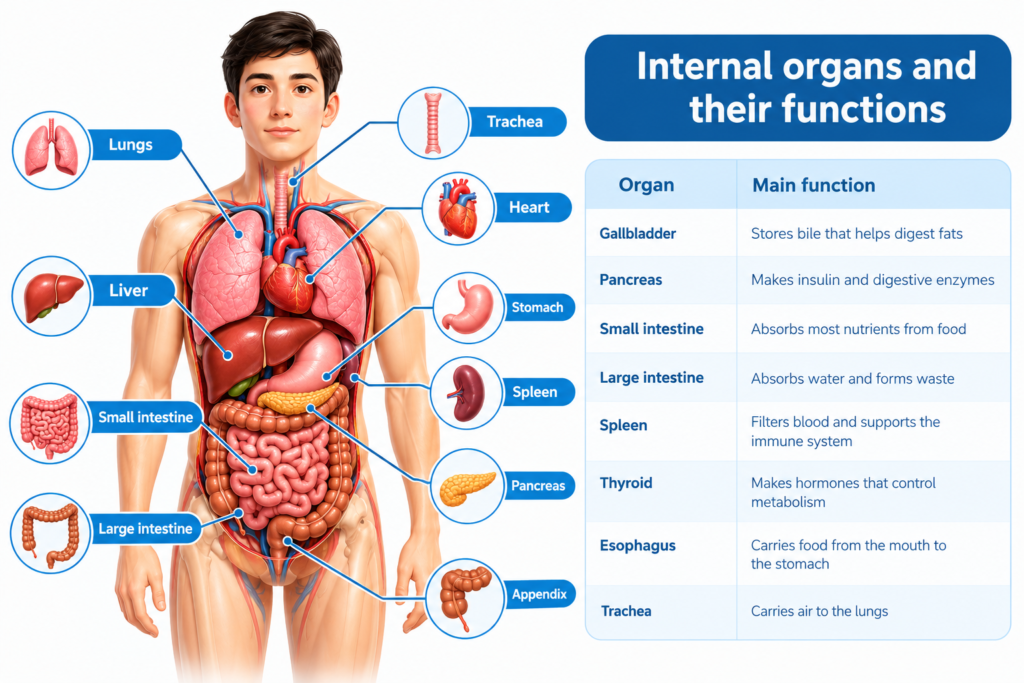
Internal parts are the organs inside the body. Most of them work quietly without any effort from us. Many work together in groups called systems. The eight organs above are the best known. The table below adds eight more that are just as important.
| Organ | Main function |
|---|---|
| Gallbladder | Stores bile that helps digest fats |
| Pancreas | Makes insulin and digestive enzymes |
| Small intestine | Absorbs most nutrients from food |
| Large intestine | Absorbs water and forms waste |
| Spleen | Filters blood and supports the immune system |
| Thyroid | Makes hormones that control metabolism |
| Esophagus | Carries food from the mouth to the stomach |
| Trachea | Carries air to the lungs |
Vital organs
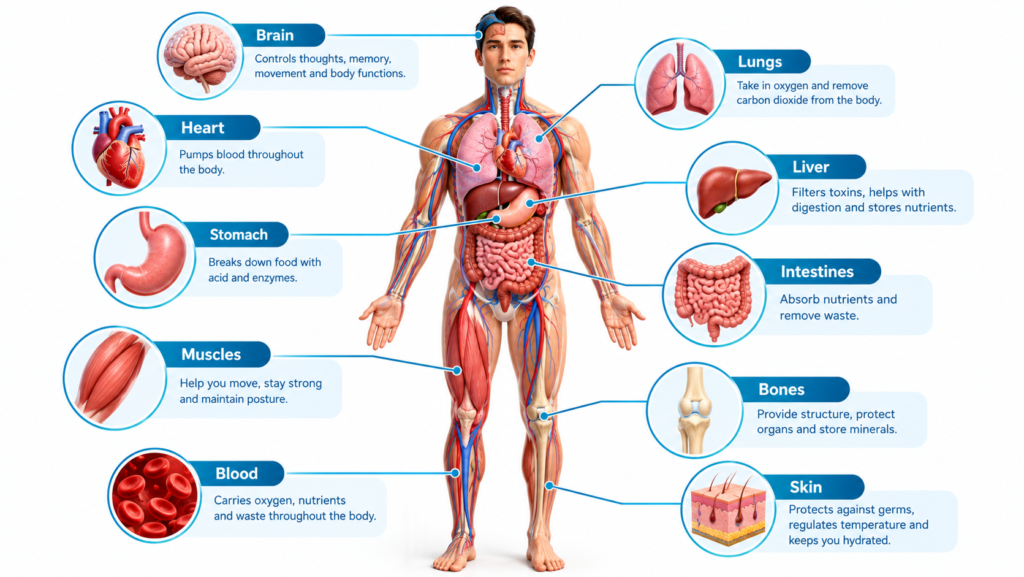
The brain and heart and lungs and liver and kidneys are called vital organs because the body cannot survive long without them. The brain controls nearly everything while the heart keeps blood moving. The lungs supply oxygen and the liver and kidneys clean the blood. Good food and sleep and daily movement help protect all of them.
Digestive organs
Food travels from the mouth through the esophagus to the stomach and then to the small and large intestines. The liver and pancreas and gallbladder help by adding digestive juices. This long path breaks food into nutrients the body can use. Whatever is not needed leaves as waste.
Female body parts and their names
Most body parts are the same for everyone. The main difference is in the reproductive system. The table below lists the common female reproductive organs and what they do.
| Body part | What it does |
|---|---|
| Ovaries | Produce eggs and hormones such as estrogen |
| Fallopian tubes | Carry the egg from the ovary to the uterus |
| Uterus | Also called the womb where a baby grows during pregnancy |
| Cervix | Lower narrow part of the uterus |
| Vagina | Muscular canal that connects the cervix to the outside |
| Vulva | The external female genital area |
The breasts are not reproductive organs. They hold mammary glands that produce milk after childbirth.
Using correct and clear names helps girls and women talk about their health with confidence and makes visits to a doctor easier. Parents and teachers are encouraged to teach proper names early and calmly. Honest and age appropriate teaching builds trust and body safety.
See a doctor for pain or unusual bleeding or any symptom that worries you. Regular checkups and screening tests suited to your age are important. A doctor or nurse can explain more and answer private questions.
Body systems and how they work together
Body parts do not work alone. They are grouped into systems that handle big jobs such as moving or breathing or digesting. Understanding systems makes it easier to remember what each part does. You can also explore more guides on the human body and health for related topics.
| System | Main parts | Main job |
|---|---|---|
| Skeletal | Bones and joints | Gives shape and protects organs |
| Muscular | Muscles and tendons | Allows movement |
| Circulatory | Heart and blood vessels | Moves blood around the body |
| Respiratory | Nose and trachea and lungs | Supplies oxygen |
| Digestive | Mouth and stomach and intestines | Breaks down food |
| Nervous | Brain and spinal cord and nerves | Controls and senses |
| Urinary | Kidneys and bladder | Removes liquid waste |
| Reproductive | Organs that create new life | Reproduction |
| Skin and immune | Skin and spleen and white blood cells | Protection from germs |
The skin is the largest organ of the body. It protects against germs and controls temperature and senses touch. An adult has 206 bones which protect organs and support movement and hundreds of muscles pull on them to create motion. Regular exercise keeps both strong.
Learning with pictures
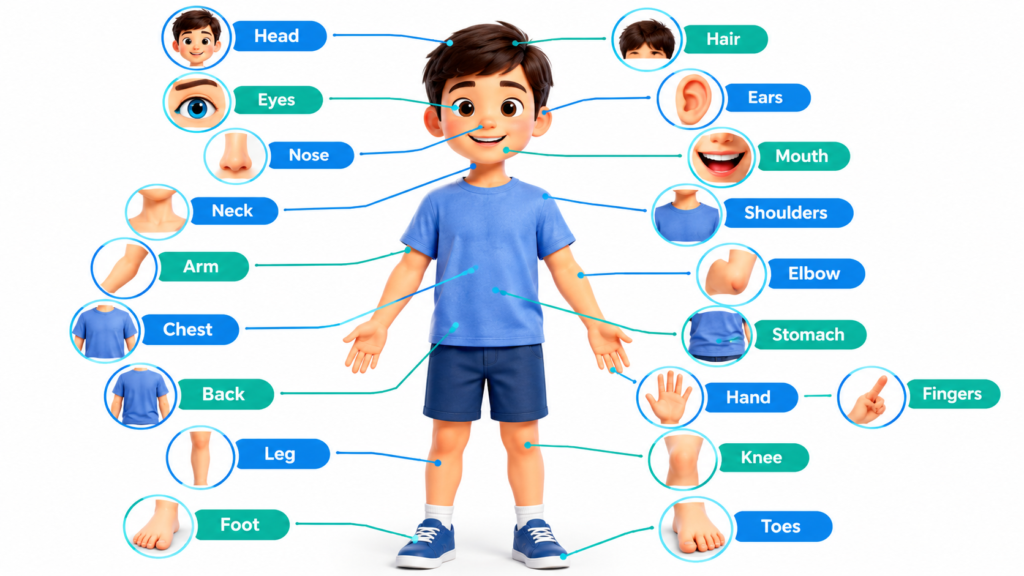
Pictures make learning much easier. A labeled diagram links each word to its place on the body. This is especially useful for children and for people learning English.
A helpful diagram has large clear labels and lines that point to the right part. It should show both a front view and a back view. For internal organs it should show how they sit in relation to one another. Look for sources from schools and trusted health organizations and choose a level that matches the learner. A young child needs simple colorful labels while an older student can use more detail.
To practice point to each part on the picture and say the name aloud. Then point to the same part on your own body. Cover the labels and test yourself or a friend. Repeat a few times each week until the names feel natural.
Body parts names for kids and English learners
Children learn best through play and repetition. Songs and games and simple actions help them remember each name. English learners benefit from the same methods plus short daily practice.
Easy activities for kids
Play a game where you call out a body part and the child touches it. Sing a simple song that names parts in order. Draw a person together and label each part. These activities turn learning into play and help children keep the names for a long time.
Tips for English learners
Start with the easiest parts such as head and hands and feet. Learn small groups at a time such as face parts or hand parts. Say each word aloud and use it in a short sentence such as I wash my hands or My head hurts. Review old words each day before adding new ones. Writing words next to a picture also helps memory.
How to remember the names and avoid mix ups
Group names by region and review a small group each day. Use pictures and say names aloud. Link each name to a function so the word has meaning. Five minutes a day on one region is enough and after a week you can review all regions together.
Many learners try to memorize too many words at once or skip internal organs. Learn external parts first and then add internal ones step by step.
Some names are often confused. The table below shows common mix ups and how to tell them apart.
| Confusing pair | Difference |
|---|---|
| Shin and calf | Shin is the front of the lower leg and calf is the back |
| Throat and neck | Throat is inside and neck is the outer part |
| Stomach and abdomen | Stomach is an organ and abdomen is the belly area |
| Arm and forearm | Arm usually means the whole limb and forearm is the part below the elbow |
| Palm and hand | Palm is the inner surface and hand is the whole part |
| Hip and waist | Waist is above the hip joint |
Frequently asked questions
What are body parts names?
Body parts names are the words for each region and organ of the body such as head and arm and heart and lungs.
What are the main external body parts?
The main external parts are the head and neck and shoulders and arms and hands and chest and back and abdomen and legs and feet.
What are internal body parts names?
Internal parts include the brain and heart and lungs and liver and stomach and kidneys and intestines and bladder.
Is there a list of 50 body parts name in English?
Yes. The tables above give exactly 50 common body parts in English grouped by region with a short note on what each one does.
What are the female body parts?
Most parts are the same for everyone. The female reproductive organs include the ovaries and fallopian tubes and uterus and cervix and vagina and vulva.
How many bones are in the human body?
An adult has 206 bones.
What is the largest organ of the body?
The skin is the largest organ.
How can I learn these names quickly?
Use labeled pictures and say each name aloud and point to the part on your body. Review a small group each day.
What is the difference between an organ and a body part?
An organ is a body part with a specific job such as the heart. A body part can also be an outer area such as the elbow or knee.
Final thoughts
Knowing the names of body parts is a basic skill that helps in school and daily life and healthcare. A clear list grouped by region makes learning easier. Adding functions and pictures turns simple words into real understanding.
Start with the parts you can see and move inward to the organs. Practice a little each day and use labeled diagrams. If you want to keep learning you can read more health and wellness guides on the site.