

Last updated: October 20, 2026
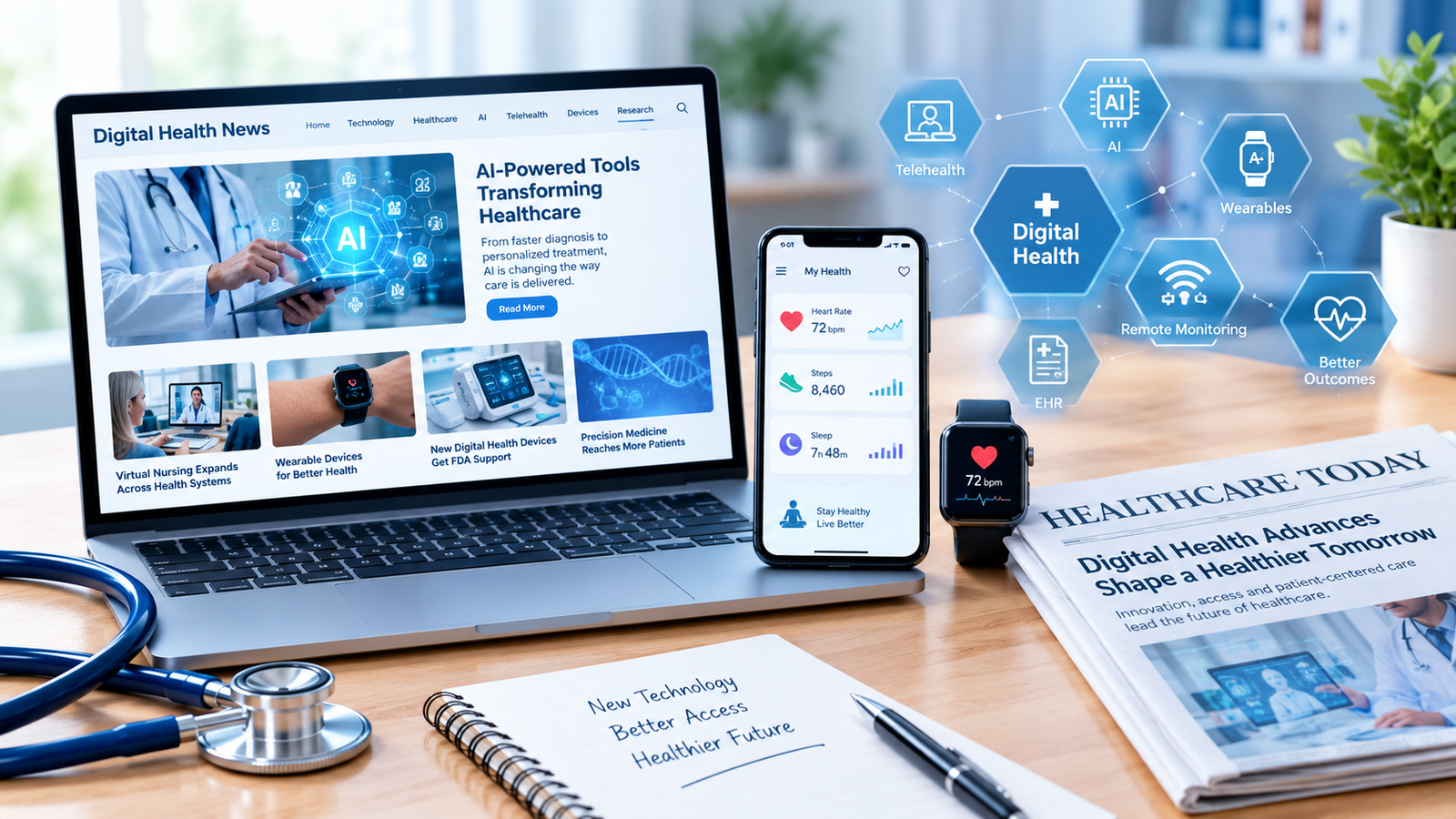
Digital health news today covers how technology is changing the way people get care. This week the biggest stories are about AI tools used by doctors, new rules for AI medical devices, smarter wearables and apps that make booking care easier. This page collects the most important updates in one place and explains them in plain language.
We update this page every few weeks. Each update lists the date and the source so you can read the original report. If you want to know how AI is used in hospitals in more detail, read our guide to AI in healthcare.
This article is for general information only. It does not replace advice from a doctor or other qualified health professional.
Digital Health at a Glance
| Fact | Detail |
|---|---|
| What it is | Use of digital tools such as apps, AI, wearables and telehealth to support health and care |
| Countries with a national digital health strategy | 129, according to WHO |
| Adults who use a wearable | About 30% |
| Biggest theme in October 2026 | AI tools used by clinicians and new rules for AI medical devices |
| Key regulator in the US | FDA Digital Health Center of Excellence |
| Global plan | WHO Global Strategy on Digital Health, extended to 2027 |
Top Digital Health News This Month (October 2026)
| Date | Update | Why it matters |
|---|---|---|
| Oct 20 | VA launches real-time scheduling with outside specialists | Fewer phone calls and faxes when veterans need outside care |
| Oct 19 | Study shows doctors mostly use AI for treatment questions | AI is already part of daily clinical work, but accuracy still needs testing |
| Oct 19 | Wearables add AI coaching for sleep, stress and activity | Useful for habits, but most are not medical-grade tests |
| Oct 19 | FDA comment period on generative AI medical devices closes | Shapes how chatbot-style AI in medical devices will be checked for safety |
| Oct 16 | US agencies warn health systems about attacks on network devices | Patient data safety depends on strong cybersecurity |
| Oct 14 | Labcorp and Thrive Global launch a heart and metabolic health test | Lab results now come with small daily habit tips |
| Oct 14 | Zocdoc buys Sohar Health for instant insurance checks | Patients may see coverage and costs before they book |
| Oct 12 | Stryker plans a $400 million investment in CMR Surgical | Shows strong interest in robotic surgery |
Latest Digital Health Updates Explained
Doctors Mostly Use AI for Treatment Questions
A study published in JAMA on October 15, 2026 looked at how clinicians use OpenEvidence, a free AI tool that answers medical questions with citations. Researchers from Harvard Medical School, Mass General Brigham and other centers studied more than 270 million questions from about 950,000 clinicians.
| Finding | Number |
|---|---|
| Physician questions about treatment and management | 33.1% |
| Physician questions about diagnosis | 13.9% |
| Monthly active users in January 2024 | 355 |
| Monthly active users in June 2026 | 703,265 |
| Returning users by June 2026 | 92.5% |
The researchers also gave a warning. They said the accuracy of these tools for treatment and medicine questions is still largely unmeasured. Better testing is needed before we know how much they help patients.
FDA Rules for Generative AI Medical Devices
In August 2026 the FDA released a discussion paper on how to regulate medical devices that use generative AI. Public comments closed on October 19, 2026. The paper suggests testing these devices in a way similar to how doctors are trained and checked before they treat patients.
The FDA said these devices may carry risks that older software does not. The paper also covers monitoring devices after they reach the market and newer agent-style AI systems. You can read more on the FDA digital health page.
Wearables Add AI Coaching
About 30% of adults now use a wearable such as a smart watch, fitness band or smart ring. New devices give personal tips about sleep, stress and exercise. For example, a band may suggest a short walk when stress rises or a regular bedtime.
A doctor from WashU Medicine said wearables can motivate people to move more. She also said most are not medical-grade tests and will not give a diagnosis on their own. Their main value is helping your doctor decide if more checks are needed.
Easier Booking and Insurance Checks
Two updates aim to make getting care less of a hassle. The US Department of Veterans Affairs launched a system built with Epic and WellHive. VA staff can now see open appointments with outside specialists and book them in real time without phone calls or faxes.
Zocdoc bought Sohar Health on October 2, 2026. Sohar checks insurance coverage using basic details like name and date of birth. It connects to more than 1,000 health plans. The goal is to show patients whether a doctor is in network and what they may pay before the visit.
Lab Tests Linked to Daily Habits
Labcorp and Thrive Global launched the Thrive 5 Health Test on October 14, 2026. It checks five heart and metabolic markers.
| Marker | What it tells you |
|---|---|
| ApoB | A measure of particles that carry cholesterol |
| hs-CRP | A sign of inflammation in the body |
| HbA1c | Average blood sugar over about three months |
| Blood pressure | Pressure in your blood vessels |
| BMI | A rough guide to weight for height |
Results come with small daily habit tips on nutrition, movement, sleep, stress and social connection. This links digital health with everyday wellness. To learn which foods give the most nutrition per bite, see our guide to the most nutrient dense foods.
Cybersecurity Warnings for Health Systems
On October 8, 2026, CISA, the FBI and the NSA issued a joint warning about attacks on network edge devices such as VPNs. They advised organizations to patch known weaknesses, turn off unused services and require multi-factor login. As more care moves online, protecting patient data is as important as the technology itself.
Investment in Robotic Surgery
Stryker plans to invest about $400 million in CMR Surgical, the UK company behind the Versius surgical robot. The deal still needs regulatory approval. It shows that large medical companies continue to bet on robot-assisted surgery.
Global Picture from WHO
The World Health Organization extended its Global Strategy on Digital Health to 2027. According to WHO, 129 countries now have a national digital health strategy. More than 1,600 government officials have received training in digital health and AI. A new plan for 2028 to 2033 is being prepared. Read more on the WHO digital health page.
What This Means for You
Most of these changes happen inside hospitals and tech companies. But they slowly reach patients through apps, wearables and easier booking. Here is how to use digital health tools in a safe and useful way.
| If you use | Do this | Avoid this |
|---|---|---|
| A smart watch or ring | Use it to build habits like sleep and daily steps | Treating its readings as a diagnosis |
| A health app | Check who made it and read its privacy policy | Sharing data with apps that sell it |
| An AI chatbot for health questions | Use it to prepare questions for your doctor | Changing medicine based on chatbot answers |
| Telehealth visits | Keep your records and test results ready | Skipping in-person care when your doctor asks for it |
| Home lab tests | Share results with your regular doctor | Starting supplements or diets without advice |
Pros and Cons of Digital Health
| Pros | Cons |
|---|---|
| Faster access to care and information | Privacy and data security risks |
| Tools that support healthy daily habits | Many consumer devices are not medical-grade |
| Less paperwork for booking and insurance | AI accuracy is not always proven |
| Helps doctors track patients between visits | Not everyone has the same access to technology |
Privacy Tips for Health Apps and Wearables
- Read the data-sharing policy before you sign up.
- Turn off sharing you do not need, such as location or contacts.
- Use a strong password and turn on two-step login.
- Delete old apps you no longer use.
- Ask your doctor which tools they trust before you rely on one.
Digital tools work best when they support healthy basics. Good food, regular movement, enough sleep and stress control still matter most. For simple ideas, read our guide to building healthy daily habits.
What to Watch Next
Three areas will likely lead digital health news in the coming months. The FDA is expected to follow up on its generative AI paper. More studies will test whether AI tools used by doctors actually improve patient outcomes. And wearables will keep adding health features, so questions about accuracy and privacy will grow. We will add new updates to this page as they happen.
Frequently Asked Questions
What is digital health news today?
It is the latest news about technology in healthcare. This includes AI tools, health apps, wearables, telehealth and new rules for medical technology.
What are the biggest digital health trends in October 2026?
The main trends are AI tools used by doctors, FDA rules for generative AI devices, AI coaching in wearables and easier online booking and insurance checks.
How are doctors using AI right now?
A large 2026 study found doctors mostly ask AI tools about treatment and medicines. Diagnosis questions were less common. Researchers say accuracy still needs more testing.
Can a smart watch diagnose a health problem?
Usually no. Most wearables are not medical-grade tests. They can show patterns that you can share with your doctor, who then decides if tests are needed.
Is my health data safe in apps?
It depends on the app. Read the privacy policy, limit what you share and choose apps from trusted makers.
Will digital health replace doctors?
No. Most tools are built to support doctors and nurses. Human judgment is still needed for most health decisions.
Conclusion
Digital health news today shows care becoming more connected. Doctors use AI every day, regulators are setting new rules and patients get more tools on their wrist and phone. The key question is not how advanced a tool is but whether it helps people safely. Use digital tools to support healthy habits and good questions for your doctor. Check back for regular updates.
Sources
- Healthcare IT News: VA real-time external scheduling
- Healthcare IT News: Clinical AI for treatment planning study
- FDA: Generative AI-enabled medical devices press release
- First Alert 4: Wearables industry and AI
- HIT Consultant: Labcorp and Thrive Global test
- HIT Consultant: Zocdoc acquires Sohar Health
- Healthcare IT News: Cyber threat advisory
- Healthcare IT News: Stryker and CMR Surgical
- ICT&health: WHO Global Strategy on Digital Health